Decorative Wood Veneers

Decorative wood veneers highlight the natural beauty of timber. They are produced by either slicing or peeling a much larger piece of timber log into thin slices or veneers.

Overview

Decorative wood veneers are produced by either slicing or peeling a much larger piece of timber log into thin slices or veneers. The way the veneer is cut will determine the appearance of the grain.


Crown 

Veneer cut from this part of the log produce leaves with crown pattern with some straight grain either side. As the crown cut moves through the log towards the centre, the leaves become wider with the crown being narrower and more well defined, with wider straight grain sections on either side. A crown cut shows the true grain of the timber.

Image: Crown cut veneer

Quarter (false) 

The veneer produced is generally straight grain material, often with a slight swing where the faulty part of the heart of the log has been removed.

Quarter (false)

Quarter (true) 

Leaves cut in this method produce fairly straight (parallel growth rings) grain patterns.

Quarter (true)

Rotary 

Veneer produced by this method has a non-descript swirl pattern. This type of veneer is produced by peeling a log which has been centred on a lathe.

Rotary


Other veneer patterns include:

  • Birdseye - figure in veneer exhibiting numerous rounded areas resembling small eyes.
  • Quilted - blistered appearance shimmering scalloped pattern.
  • Pommele - a scalloped figure, most usually found in mahogany.
  • Burls/Burr - abnormal growth producing tightly packed buds and knots producing highly decorative veneer that mostly appear as rings and dots.
  • Figured - the markings, often forming wavy shimmering patterns, these may be regular or irregular ranging from fiddleback to block figure.


Jointing veneers
The veneer leaf - or flitches, as bundles of sliced veneer are known- is then clipped to size before being jointed into usable sized sheets called layons. Veneers can be jointed by stitching, splicing or using paper tape. Stitching and splicing are the most common methods and are generally produced by automated machinery.

See ‘Appearance Grades' for more details on matching patterns available when jointing veneers.

Bonding veneers
Pressing is the process of binding veneer layons to a substrate using specialised pressing equipment, which generally applies heat and pressure. Suitable substrates such as MDF, particleboard and plywood would generally not be appearance-grade quality and as such don't have an attractive grain or figure, making them perfect for use with the decorative veneer. Most manufacturers will supply bonded veneers trimmed and sanded.

Aside from decorative timber, timber veneers can also be joined together to create LVL and plywood. Veneer for structural applications is generally peeled.

Benefits of decorative veneer
The finished decorative veneer product will give the illusion that it is one solid piece of wood, as per the species of the face veneer. This is desirable for a number of reasons. Firstly, it provides an economical way to use timber resources, or those species that may be rare or more expensive. Secondly it means you can get the appearance benefit of certain species that may have otherwise been impractical to use for the application, ie using a solid piece of timber may not have been possible as per certain hardwood species.

Decorative veneers may also prove to be a more stable material than using a solid wood equivalent. This means that decorative veneers provide one of the most economical and sustainable applications of timber.

A further benefit of using decorative veneers is the extensive range of colours and styles available - just about any species of wood can be turned into a veneer. This provides endless opportunities for architectural applications.

Other veneered products include laminated veneers edging, profile wrapping and decorative inlays, including marquetry.
Properties

Durability

Apart from the aesthetic appeal, one of the main advantages of using decorative veneer is that it is less prone to shrinking, checking and warping than solid timber.

Decorative veneers are not practical for use in heavily wet areas or extreme weather outdoor areas, as the constant water or sun will eventually cause it to break down or discolour. Being thin they are quite responsive to humidity changes. The correct moisture content level of veneer and substrate is important to ensure a quality finish.

Moisture resistant substrates should be used for high humidity areas or areas prone to occasional wetting. The moisture content of the substrate should be between 8 per cent and 12 per cent, or ideally between 8 per cent and 10 per cent to ensure there is minimal movement between the substrate and veneer.

Sizes

Decorative veneers are usually peeled or sliced to thicknesses from .03 mm to 0.6 mm, with the aim of obtaining the best figure or grain of the timber. In contrast, veneers that are required for the production of products such as plywood and LVL are usually sliced or peeled to a thickness up to about 3 mm.

When specifying veneer, it is important to select the correct grain direction. For example:

  • 2400 mm x 1200 mm - the grain will run parallel with the 2400mm long length of the sheet and this is known as ‘Long Band'.
  • 1200 mm x 2400 mm - the grain will run parallel with the 1200mm long length of the sheet and this is known as ‘Cross Band'.

Grades

The development of grading rules for decorative veneers is made difficult due to the fact that each flitch of the veneer provides a unique pattern of figure and grain.

In Australia, an extensive range of veneer species, both native and imported, is used. All have different characteristics; varying in colour, grain pattern and features. Therefore, one set of grading rules for decorative veneers, would not fit all sliced veneer for all applications.

As per AS/NZS 1859:3 Reconstituted Wood Based Panels the following manufacturing face grades are used in Australia:

  • F2S/G2S - Face Two Sides/Good Two Sides - face quality of the veneer is required on both sides.
  • SSB - Same Species on Back sides; sometimes called DGB or Down Grade Back - same species is required for both sides of panel, with back panel not needing to be as high quality as the face side.
  • MOB - Manufacturer's Option on Back; sometimes called BAMO - Backs at Manufacturers Option - the species and quality of the back veneer are determined by the manufacturer.
  • CNB - Customer Nominated Veneer on Back - the species and quality of the back veneer is chosen by the customer.

Appearance Grades

Decorative Veneers are typically of A, S and B grade quality. C and D grades would not be used as decorative veneers, due to their non-appearance (structural) quality:

  • A Grade - a high quality appearance grade for clear finishing. Marine plywood is always manufactured using A grade veneers on both faces as this provides a product clear from defects.
  • S Grade - an appearance-grade veneer that permits natural characteristics, such as knots, which is acceptable to both the manufacturer and consumer
.
  • B Grade - designed to be painted. It provides a suitable substrate for high quality painted finished.


Commonly produced patterns
Due to the unique production of decorative veneers, it's possible to provide different patterns by using different cutting or slicing processes. These include jointing veneer leaves in the following ways:

  • Book match - the most popular method with veneer leaves folded out like a book to form a pattern.
  • Slip match - veneer leaves are laid side by side with the grain pattern repeated at the width of each leaf across the layon.
  • Reverse slip match - As per slip match but with alternate leaves turned upside down. May be used to provide a more balanced design for crown cut veneers.
  • Random match - veneer leaves are randomly matched for a design effect. Usually done with veneers that feature clusters of knots.


Special matching techniques
More labour intensive or specialised designs may be offered by individual veneer manufacturers. These can include the following patterns generally produced on production line equipment:

  • Diamond
  • Reverse Diamond
  • Herringbone
  • V Match 
  • Box Match
  • Reverse Box Match.


The following matching techniques are more labour intensive and may be hand made, so can be more expensive to produce:

  • Quarter Matching - the most common method of joining burls. The veneer is matched in ‘fours' using a book and end match. The pattern can be continued in all directions until the required panel size is obtained.
  • End Matching - the veneer is matched end to end to create a longer veneer Also known as Butt Joining.
  • Sun Burst - the veneer is sliced into wedges which are then used to create a sun or star pattern.

Regulations / Standards & Codes

In Australia, there are no standards or grading rules related specifically to decorative sliced veneers. Therefore, most Australian veneer producers use the Standard AS/NZ 2270 Plywood and blockboard for interior use. The standard specifies the requirements for face and back veneers and is applicable to both rotary peeled and sliced veneers.

Detailed requirements for veneers used for the manufacture of veneered panels are specified in the Australian/New Zealand Standard AS/NZS 1859.3 Reconstituted Wood-Based Panels Part 3: Decorative Overlaid Wood Panels. Grading rules described in this Standard have been adopted by the Australian veneer industry and they are widely used when specifying veneered boards. The grades are described in the Veneer Product Information Manual developed by DWVA.

Decorative Wood Veneers Association has developed a Quality Assurance program which manufactures in accordance with the following standards:

Substrate
AUS/NZ 2270 Plywood & Blockboard for interior use. 

AS2271 Plywood & Blockboard for exterior use.

AS/NZS 1859.3 Reconstituted Wood Based Panels is made up of a series of standards. Part 1 deals with Particleboard; Part 2 with Medium Density Fibreboard and Part 3 with Decorative Overlaid Wood Panels.

Veneers Bond
AS/NZS 1859.03 Reconstituted Wood Based Panels provides performance requirements and specifications in the manufacture and application of decorative overlaid wood panels.

Procedures have been developed for measuring the strength of the bond between the wood veneer and the substrate, and minimum standards set which should be met by wood veneered panels. These are covered by the standard AS/NZS 1859.3 and AS/NZS 4266.32 (Veneer Bond Strength) and AS/NZS 4266.33 (Veneer Bond Durability).

As part of the Decorative Wood Veneers Association QA program, the compliance with the glue bond standards is checked regularly. Testing was developed and is monitored by the Australasian Furnishing Research and Development Institute (Furntech). The veneer industry test standard is AFRDI Standard 145 Veneer Bond Strength & Durability


*Disclaimer : The species mentioned here are just a guide and for specific information refer to Suppliers Section

Description

Material Sub Type

Marquetry
Marquetry uses small pieces of different veneers to create detailed pictures or patterns and is used mainly in furniture manufacturing. Marquetry may use many different species and grain patterns, including more exotic grains. Marquetry and other patterning applications would be impractical to create with solid wood, which is another reason why decorative veneers are perfect to achieve the ultimate timber designs.

Laminated veneer edging
LVE is produced by laminating veneer together and is used as a substitute for solid timber edging.

Profile wrapped mouldings
Veneers can be applied to mouldings and architraves to further enhance or compliment designs.

Reconstructed veneers
Reconstructed veneers are sliced from a laminated timber block made from various wood species, dyed throughout and glued together under pressure in parallel configuration. As it is made out of natural timber, it should be treated like any other veneer during the manufacturing process of joinery work.

One of the perceived benefits of reconstructed veneers is the consistency in colour and grain of the veneer. Within block lots, there is generally acceptable consistency of colour, with some subtle grain differences. Due to batch dyeing, there can be small colour variance from block to block.

As reconstructed veneers are man-made, they generally come in defined lengths. The veneers commonly available in Australia are 2500 mm and 2800 mm in length, but for specific veneers it is always best to check with the manufacturer.

Colour Description

The colour options are endless with decorative veneers and will be based on the species and finish used by each manufacturer. Colours can range from light, medium and dark to red and more exotic. Veneers can also be dyed, plus special inlays including V-Match, herringbone, diamond are also available.

It is possible that the consistency of veneer appearance may vary to some degree if different logs have been used. It is always best to confirm specific requirements with the manufacturer to ensure individual design specifications are met.

Fire Resistance

Fire resistance in the form of a fire rating can only be applied to a total building element incorporating a decorative veneer, eg paneling. A product, ie a decorative veneer can not be fire rated, but it is important to note when a product is labelled as fire resistant or fire retardant it is referring to its ability to limit ignition, flame propagation, heat and smoke release.

Apart from wall and ceiling linings, most applications that use decorative veneers - including joinery, door skins and cupboards - are exempt from BCA classification.

Rating the fire resistance of any wall or ceiling lining also has to consider both the veneer together with the type and thickness of the substrate used.

For more information about fire resistance regulations please refer to C1.10 Fire Hazard Properties within the Building Code of Australia (BCA).

Adhesives

Decorative veneers are considered to be non-structural applications as the stresses at the bonded interfaces are low. Decorative veneers would be bonded to a substrate using a Type C or D bond and may use thermoplastic (PVA, Cross-lined PVA) or thermosetting adhesives (Urea Formaldehyde). Type C and D Bond adhesives are not durable under full exposure to weather and wet or damp environments.

The bond quality of each is as follows:

  • Type C Bond (interior, non-structural) - is suitable for non-structural interior applications, or tropical locations with high humidity free from wet or damp conditions. Recognisable by its light glueline colour, it uses a Low Extension Urea Formaldeyde and is for interior bonds only.
  • Type D Bond (interior, non-structural) - is appropriate for non-structural internal low-humidity environments such as internal paneling. It uses a High Extension Urea Formaldehyde and like a Type C bond, its glueline is also light in colour.

Treatments

Decorative veneers won't be subject to the same durability issues as wood used in external and structural applications. However it is still necessary to provide some level of protective coating, usually a lacquer, to ensure they are suitable for day-to-day use and the specific application they are being used for.

As decorative veneers are used internally, the main concern to is to be wary of any moisture content issues that could affect the veneer or substrate. Decorative veneers can be used in kitchen/bathroom areas as long as the area is well ventilated and the veneers are properly sealed, eg using a two-pack polyurethane.

Timber species that have phenols, tannins and other chemicals in their cell structure, may need to be sealed with a coating that will stop the chemicals in the wood reacting with the chemicals in the top-coat.

It is advisable to check directly with the manufacturer for guidelines on the best treatment options for each type of veneer.

Design/Engineering Considerations

Veneer selection is specifically related to design. Apart from an increase in the bending strength and stiffness of a panel in the direction of the grain, the application of veneers does not affect any other properties of the substrate.

The main consideration when choosing a substrate is that a moisture resistant board is used for high humidity areas or those areas that are prone to occasional wetting.

Handling, Storage & Protection

Veneers should be stored in a dry, cool place. Exposure to UV light can cause discolouration and variations in moisture content should be avoided as this can cause veneers to swell.

Maintenance

Cleaning with a mild soap and damp rag is generally recommended. It is best to check with the manufacturer as different finishes may more require more specific maintenance.

Excessive wetting during cleaning must be avoided.

Workability

Veneered panels provide a strong, stable, easily machined, easily finished construction material for all forms of cabinetry, joinery and paneling.

Sustainability

Decorative veneers are one of the most economical ways to use wood. Instead of using a solid piece of timber to achieve a certain look, a decorative veneer will deliver the same look and feel but by only using a fraction of the timber resource.

The surface coverage provided by a decorative veneer of 0.6 mm in thickness is approximately forty times more than that provided by the same volume of solid timber of 25 mm in thickness.

Using wood veneers also provides a more efficient use of rare timber species.

Finishes

The type of finish will depend in part on the application of the veneer. Vertical low usage applications like wall paneling versus high usage, horizontal applications such as a boardroom table will determine the durability of the finish required.

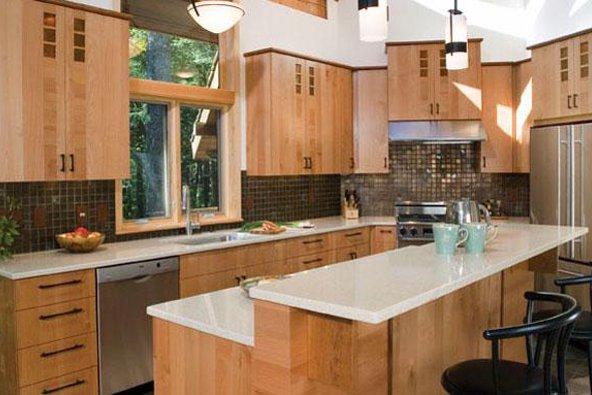
Decorative veneers can be used for kitchen/bathroom/vanity doors if the area is properly ventilated and the veneer has been sealed properly, such as with a two-pack polyurethane.

Types of veneer finishes include:

  • Single Pack Lacquer- for use on low-wearing applications. Can yellow due to UV exposure and ageing.
  • Two Pack Lacquer - includes a hardening agent and is more durable than a single pack lacquer. Can also yellow over time.
  • Two-Pack Polyurethane - offers much better wear, scratch and stain resistance than the lacquers. It also has a higher bonding property and is suitable for high traffic applications such as boardroom tables.

Finishes can be applied by brush or spray.

Table: Guidelines for selection of coating systems for veneered products

Type of finish

Properties

Typical application area

Nitrocellulose

Easy to use; fast drying; economical

Furniture, wall paneling

Pre-catalysed

Improved mar and scuff resistance; fast drying, medium water and solvent resistance

Tables, wall paneling, office furniture

Acid catalysed

High build; superior mar and scuff resistance

Dining & office furniture, utility furniture, high use areas

Polyurethane

Excellent chemical solvent and water resistance

High build; excellent mar and scuff resistance and doors, laboratory, hotel and office furniture and fittings, bars and restaurants 

Vanity & kitchen units, kitchen cupboards


Applications

  • Internal Paneling

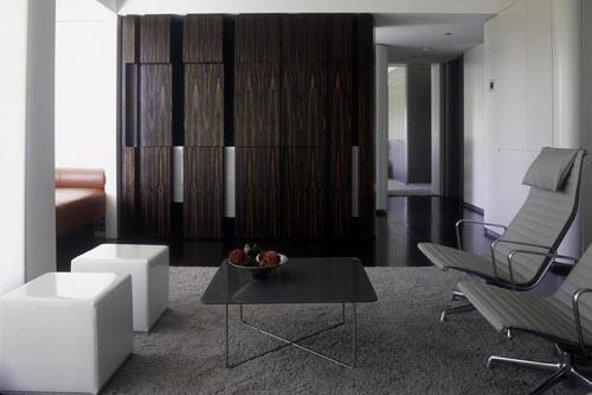
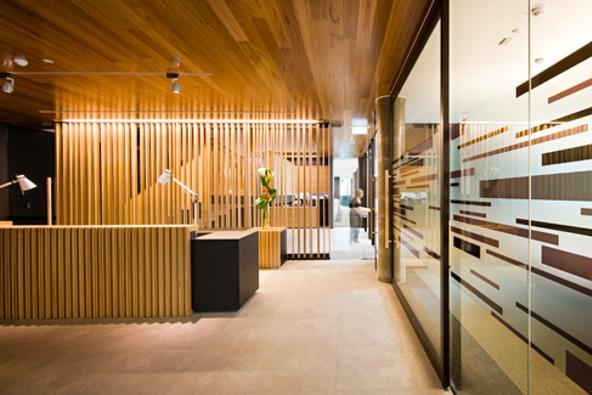
    Timber paneling creates interiors as warm as they are stylish. Commonly utilising an MDF or plywood substrate, internal timber paneling is natural and versatile and comes as either solid natural timber panels or as sheets of engineered wood products

Case Studies

  • Abigroup House, Brisbane

    Abigroup House, Brisbane Cox Rayner Architects have created an interior that presents Abigroup as a forward-thinking building company, and timber is a highly visible contribution to this effect.

    Applications : Doors, Flooring, Interior Rails and Balustrades, Interior Stairs, Internal Paneling,

  • Eastern Precinct, University of Melbourne, Parkville

    The durability and warmth of timber supports the University of Melbourne’s model, providing a new learning landscape at the Eastern Precinct Student Centre.

    Applications : Decking, Doors, External Cladding, Flooring, Internal Paneling, Windows,

  • Kew House 3

    Vibe Design Group’s, Kew House 3 uses timbers natural warmth and appeal to not only wrap a dynamic exterior but also evoke a journey of discovery within the home.

    Applications : Decking, External Cladding, Fencing, Flooring, Timber Joinery Products,

  • Mingara One Fitness Centre

    A breathtaking addition to the Mingara Recreation Club campus on the NSW central coast, covering 2000sqm of commercial gymnasium over two levels.

    Applications : Doors, External Cladding, Flooring, Interior Stairs, Internal Paneling,

  • Narrabeen House

    Narrabeen House – an innovative use of timber and timber products creates a private paradise in the suburbs.

    Applications : Doors, External Cladding, Fencing, Framing, Interior Stairs, Internal Paneling, Structural Timber Poles, Windows,

  • National Portrait Gallery, Canberra

    Jarrah, Spotted Gum, Blackbutt and Victorian Ash play an essential role in the National Portrait Gallery’s expression of Australian identity.

    Applications : Architectural Roof Trusses, External Cladding, Flooring, Framing, Interior Stairs, Internal Paneling, Windows,

Result(s) page 1 of 1

All Comments (0)

Sign In or Sign Up now to post a comment!