Download the WoodSolutions Technical Design Guide on Domestic Timber Decking here.
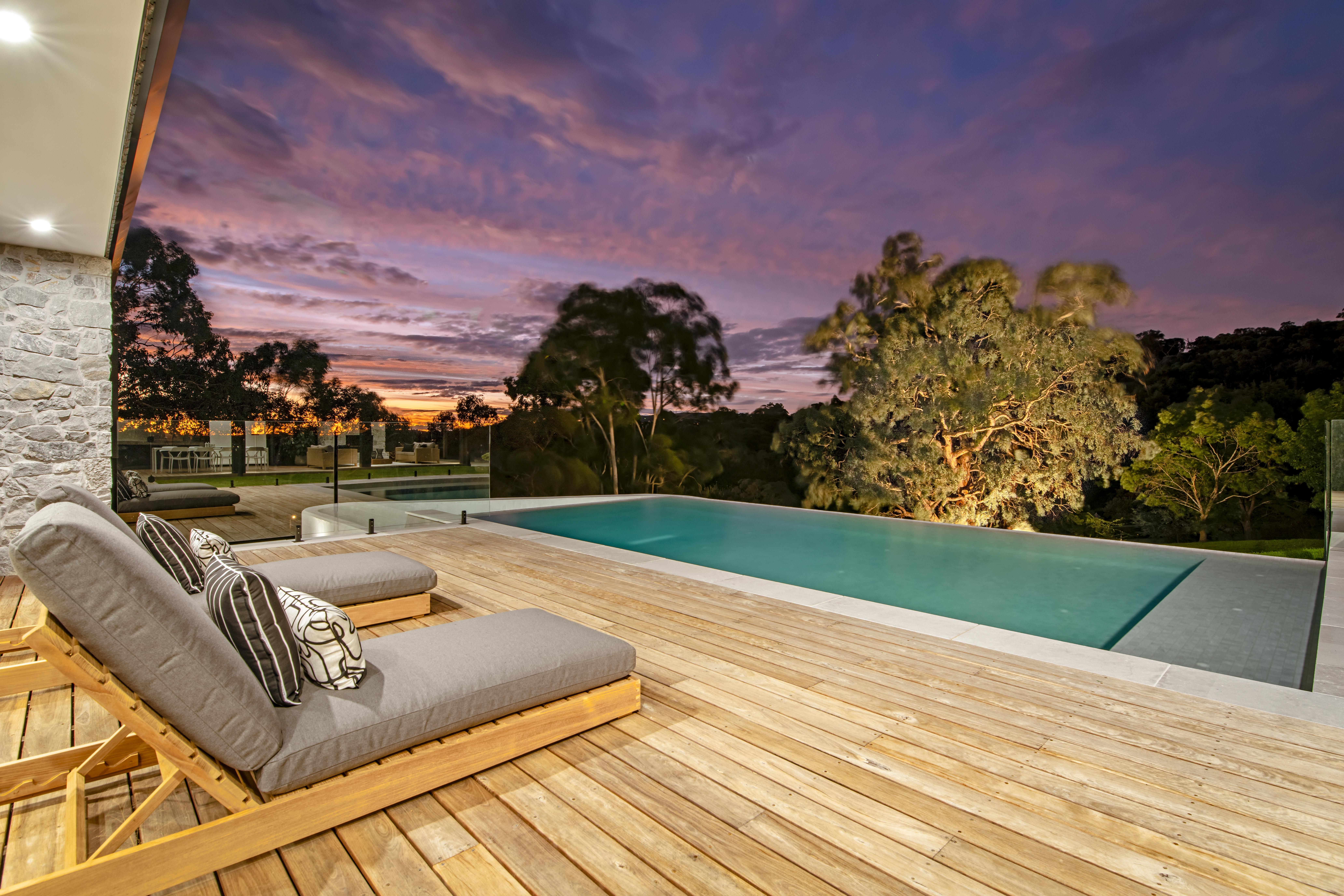
Timber decks are a practical and attractive addition to any outdoor landscape. Natural timber decks blend seamlessly with their surrounding environment and will serve as popular entertaining areas all year long.
As an external structure, carrying large loads of traffic, timber decking has high structural performance requirements. In addition decks are usually raised clear off the ground and fully exposed to the weather meaning an effective deck must be able to cope with wear and tear from repeated use and in addition discharge rainwater efficiently. Roundin the corners (easing the arris) of the decking will help run off water while spacing for ventilation between the decking boards will prevent water ponding on the deck surface.
Timber decking is available in both seasoned and unseasoned wood, in a wide range of species, sizes and grades. The natural appeal and strength of timber makes it a practical choice for outdoor decking. This guide provides an overview of best practice methods for specifying, installing and finishing a timber deck.
Timber decking is continuously exposed to all weather conditions and subjected to regular changes in moisture content, therefore its seasoning and drying requirements are different to other milled product and the relevant standards reflect this.
External decking timbers exposed to the weather will reach Equilibrium Moisture Content (EMC) with their surroundings after a period of 9-18 months depending upon prevailing weather, size and type of timber used.
Depending on location, the amount of shrinkage occurring in unseasoned timber will vary.
Accordingly, allowance must be made for shrinkage in bearers, joists and decking and for the gaps that will occur between the decking boards. Generally about 6% shrinkage (6mm/100mm width of board) should be expected for unseasoned hardwood.
Seasoned decking should be laid with the required gap at installation. Closing of these gaps may take place during prolonged wet periods and gaps not less than 4mm should be provided.
AS/NZS 1170.1 - Structural design actions - Permanent, imposed and other actions, provides guidance on the live loads (point and uniformly distributed loads) required for most commercial and industrial applications. In general, minimum uniformly distributed loads for commercial applications are of the order of 4.0 kPa with point loads varying from 4.5 kN up to 31 kN . For decking, point loads will usually govern design.
Tables for 2.0 kPa to 4.0 kPa UDLL are published by CSIRO. It should be noted that the span tables do not account for heavy point loads and therefore member stresses should be checked for loads in excess of 10kN. AS 1720.1 Timber structures standard provides rules for this including load sharing and distribution factors for parallel and grid support systems.
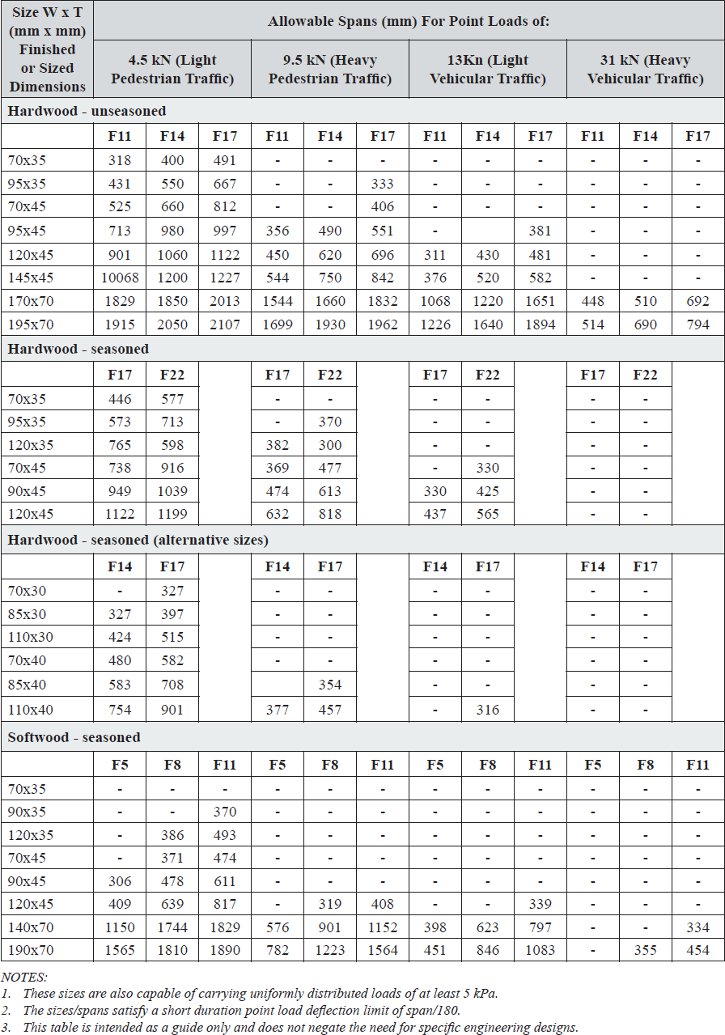
The following table shows the allowable spans for various grades and sizes of timber decking. Generally, the closer the joist spacing, the better restrained the decking boards and the less likely they are to distort during service.
Criteria Level: 2.03
The provision of adequate ventilation will significantly enhance the long term performance of the decking and timber sub-structure. Wider spacing between boards equals greater ventilation. Board spacing of 4mm is recommended as a minimum. Where decks are placed over damp or wet ground or directly over water, care should be taken to avoid dead air pockets.
Criteria Level: 3
The decking application is demanding on timber however the advantages of the material continue to satisfy both design and construction requirements. Addressing some important pre-installation considerations will ensure a deck of strength, quality and durability for many years to come.
Criteria Level: 3.01
Timber delivered to site should be stored on dry ground, supported on level bearers 150mm high. Until required, the timber should be left block stacked and banded. Both seasoned and unseasoned decking boards should be covered to protect against the weather.
Criteria Level: 3.02
To minimise moisture uptake and reduce the likelihood of cupping it's recommended that one coat of a water repellent preservative or an oil based primer followed by a coat of the intended finish be applied to the surface of joists and to all surfaces of decking prior to fixing.
To reduce end-splitting in unseasoned timber, the end-grain should be coated immediately after sawing with a suitable sealer such as petroleum jelly or Mobilcer-M Wax Emulsion. In addition, all unseasoned sections 300 x 75mm or greater should be end-plated with a multi-toothed plate connector covering at least 50% of the exposed end section. Specify timber to be supplied with the end-sealing and plating in place.
Criteria Level: 3.03
All metal fixings should be either stainless steel, monel metal or hot dipped galvanised or mechanically plated to comply with AS 1650. The table below provides relevant fastener details for the fixing of decks.
All bolts in bearer to joist and bearer to support connections should be hot dipped galvanised and conform to AS 1111. As per AS 1511, nuts should be turned snug tight and all joints should be checked and re-tightened after 6 months. Where retightening is not possible, a volute coiled stainless steel spring washer should be used to maintain a tight fit as the timber shrinks due to moisture loss. Fasteners used with CCA treated timber, in the presence of continual moisture should be coated with a heavy bodied grease prior to installation.
|
Decking Thickness (mm) |
Nails |
Corrosion Protection |
Screws |
Corrosion Protection |
|
30-35 |
100 x 3.4 Gun Nail Flat Head |
Hot dipped galvanised |
75 x No. 14 Type 17 Batten Screw |
Hot dipped galvanised |
|
100 x 3.75 Flat Head (pre-drilling may be required) |
Hot dipped galvanised |
75 x No. 14 Type 17 Hex-Head Roof Screw (requires countersink for Head) |
Stainless steel or hot dipped galvanised |
|
|
40 – 45 |
125 x 5.6 Dome Head Decking Spike (pre-drilling required) |
Hot dipped galvanised |
90/100 x No. 14 Type 17 Batten Screw |
Hot dipped galvanised |
|
90/100 x No.14 Type 17 Hex-Head Roof Screw ( requires countersink for head) |
Stainless steel or hot dipped galvanised |
|||
|
70 |
200 x 9.0 Decking Spike |
Hot dipped galvanised |
- |
- |
Criteria Level: 3.04
For unseasoned timber, bolt holes should be drilled to bolt diameter plus 10% and allowance made for shrinkage. Where multiple connectors are used with steel or where timber members cross, shrinkage restraint will occur.
Pre-drilling of screws and nails may also aid in avoiding splitting. Trial fastening is recommended to determine tendency to split. If pre-drilling is required, the pre-drilled hole should be approximately 80% of the shank diameter of the screw or nail. The size of fastener required to fix the decking boards may dictate the minimum floor joist thickness. The table below provides further guidance in this regard.
|
Nail Size (dia. mm.) |
Screw size (dia. mm.) |
Minimum Floor Joist Width (mm) |
|
Up to 3.75 |
- |
50 |
|
4.5 to 5.6 |
Up to 6 |
75 |
|
9 (deck spikes) |
- |
100 |
Criteria Level: 3.05
Joint durability is critical in ensuring a sound, strong and durable long term structure. When designing joints in timber decks:
• Keep the contact between members in a joint to a minimum
• When possible make all joints self draining
• Where the contact area is excessive or durability in the joint may be a problem, use a preservative paste or a bitumastic type sealer on the contact surfaces
• Give consideration to the joint as the members season and avoid bolt or nail configurations which are likely to cause splitting as the timber seasons
• Seal all end-grain with a suitable water repellent sealer
• Ensure the joint receives as much natural ventilation as possible
Criteria Level: 1
Decking is available in both seasoned and unseasoned timber in a wide range of species, grades and sizes. Hardwood is the traditional timber used for decking and remains a popular choice due to its ready availability, natural durability and proven performance with minimal maintenance. With pressure preservative treatment and greater availability, seasoned softwoods are now also widely used in applications such as footbridges and boardwalks.
Criteria Level: 1.01
In general decking boards are available plain (square edged), with pencil round or arrised edges or with one reeded or ribbed surface as illustrated by the following figure.
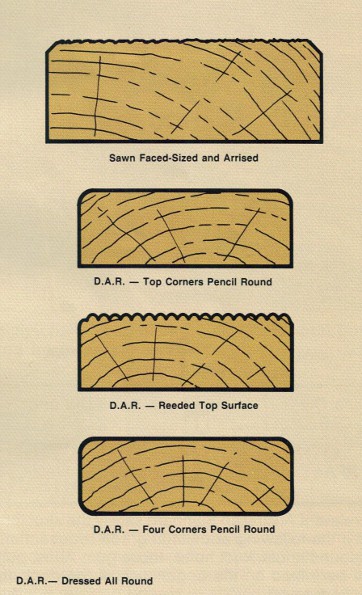
Cross-section dimensions for Australian decking timbers.
| Timber | Cross-Section (mm x mm) | Stress Grades | Availability by state |
| Hardwood - Unseasoned | 75 X 38 to 200 X 75 |
F14, F17 F11,F14 |
Qld NSW, Tas, Vic, WA, SA |
| Hardwood-Seasoned |
70 x 35/45; 90 x 35/45 120 x 35/45 70 x 30/40; 80 x 30/40; 110 x 30/40 |
F17, F22 F14, F17 |
Tas Vic WA SA |
|
Softwood-Seasoned (including preservative treated pine) |
70 x 35/45; 90 x 35/45; 120 x 35/45; 140 x 70; 190 x 70 | F5, F8, F11 | All States |
Criteria Level: 1.02
When selecting species for decking applications, prior to considering the physical grading the first criterion in specifying a decking project must be durability. Current building regulations require that timber for exposed applications should be of durability class 1 or 2. In some situations, the climatic conditions, the reduced risk of insect attack or the careful detailing for durability (e.g. the use of flashings, protective coatings) may be such that a lower durability could be used.
Posts in contact with the ground should be either cypress (sapwood free) preservative treated pine or a durability class 1 hardwood, with any sapwood preservative treated. Some durability class 2 hardwoods may be used for in-ground applications if they can be easily replaced should decay occur.
Decking and deck framing above ground should be either cypress preservative treated pine or durability class 1 or 2 hardwood. Hardwood decking boards and deck framing containing sapwood must be preservative treated.
Preservative treatment for posts in the ground and framing closer than 150mm to the ground should be to hazard level H5. Preservative treatment for framing more than 150mm above ground should be to H3.
| Timber | Cross-Section (mm x mm) | Stress Grades | Availability by state |
| Hardwood - Unseasoned | 75 X 38 to 200 X 75 |
F14, F17 F11,F14
|
Qld NSW, Tas, Vic, WA, SA
|
| Hardwood-seasoned |
70 x 35/45; 90 x 35/45 120 x 35/45 70 x 30/40; 80 x 30/40; 110 x 30/40
|
F17, F22 F14, F17
|
Tas Vic WA SA |
| Softwood - Seasoned (including Radiata pine) | 70 x 35/45; 90 x 35/45; 120 x 35/45; 140 x 70; 190 x 70 | F5, F8, F11 | All States |
Criteria Level: 1
For every decking application several aspects of workmanship should be considered, as outlined below.
Criteria Level: 1.01
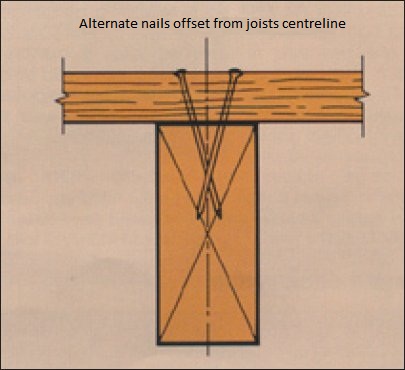
A trial panel of decking should be prepared to assess the potential splitting problems of undrilled nails, spokes or screws. If required pre-drilling should be carried out for the full length of the nail. At intermediate fixings nails should be either offset or driven at slightly opposing angles. Nails should be driven flush to surface level.
Criteria Level: 1.02
Bolt holes should be drilled straight approximately 10% larger than the bolt diameter. (Do not bend or force bolts into holes.)
Criteria Level: 1.03
To prevent lateral movement decks should be braced with double diagonal 100 x 38mm hardwood or 90 x 45mm treated pine, halved at the crossing.
Decks attached to the building should have double diagonal bracing either fixed to the underside of joists with each brace fixed to each joist with 75mm No.14 Type 17 batten screws or two 75 x 3.15mm nails. Or alternatively for decks greater than 1800mm high, fixed between a pair of posts, parallel to the wall, with the ends of braces bolted to posts with 12mm diameter bolts.
Freestanding decks greater than 1800mm high should be braced in both directions with double diagonal braces between at least two pairs of posts at right angles. For those less than 1800mm, embedding posts in the ground provides the required lateral bracing.
Criteria Level: 1.04
Timber posts should be fixed to hot dipped galvanised steel stirrups set in concrete. A minimum clearance of 75mm between the top of the concrete footing and the bottom of the post should be provided as a termite inspection zone.
Criteria Level: 1.05
Bearers can be adequately fixed to posts by sitting them on top of posts, fixed with proprietary post caps or brackets in accordance with manufacturer's instructions. Alternatively bearers may be housed into posts and bolted with two 12mm diameter bolts (minimum 35mm of post to remain after housing)
For double bearers, or where posts continue up to support handrails or roofs, bearers should be partially housed (10mm nominal) into side of posts and bolted with two 12mm diameter bolts.
Seasoned double bearers may be either spaced or nail-laminated together with staggered nails at a spacing equal to twice the bearer depth. The spacing method requires solid timber spacing blocks to be provided and bolted between the bearers at mid-span.
Criteria Level: 1.06
Joists should be fixed on top of bearers and ledgers at 450mm maximum spacing with either two 75mm x 3.15mm skew nails or proprietary framing anchors or brackets.
Alternatively, joists may be installed in line with bearers and/or ledgers and fixed to proprietary joist hangers in accordance with manufacturer's recommendations.
Joists 35, 38, 45 and 50mm wide are all structurally adequate. Joists 45 and 50mm wide are recommended because they are less prone to splitting and provide better bearing and fixing for decking boards at joins and ends. Joists 35 or 38mm wide may be suitable for use where decking is fixed to sides of joists with proprietary fixings. (refer AS1684 for a larger range of joist sizes).
Where the depth of joist is greater than four times the width, solid blocking should be provided between joists at each support. For joists spans over 3m, additional herringbone strutting or solid blocking should be provided in evenly spaced rows. One row, for spans over 3.0m to 4.2m and two rows equally spaced for spans over 4.2m
Criteria Level: 1.07
For decking boards butted lengthwise, the butts should be tight with no gaps. A slight backcut will assist in ensuring a tight fit. For boards fitted side by side, any variation in gap width between boards should be eliminated. The finished gap width after seasoning should be between 6mm and 10mm. For seasoned decking a gap of 4mm is recommended. In unseasoned timber, mitre cuts should be cut with an internal angle of 47 degrees to allow for uneven shrinkage across the cut. This allowance will result in parallel gaps at the mitre, after shrinkage.
Each board should be fixed at every joint crossing with two nails. Alternatively, proprietary fixings may be used in accordance with manufacturers instructions. Nails must be hot dipped galvanised or stainless steel. For decking within one metre of swimming pools, stainless steel or silicon bronze fixings are recommended.
Criteria Level: 1.08
All discarded building materials should be removed from the deck area as soon as possible after cutting to avoid staining of underlying boards. Re-grading is recommended for any timber that is damaged during storage or because of poor-handling.
Criteria Level: 1
All decks require a finish to provide protection against external elemants. If left unfinished timber exposed to the weather will fade to a silver grey colour and can distort, developing splitting and surface checking.
Criteria Level: 1.01
WRPs are usually water repellent materials in a light organic solvent base that often include chemicals that inhibit decay. As they provide protection against moisture they are recommended as a priming coat for other coatings, however the WRPs compatibility with other intended coatings should first be checked. Generally two weeks is required between application of a WRP and other finishes.
Criteria Level: 1.02
While opaque paint finishes provide the best protection against weathering, they obscure the natural colour and grain of timber. Pale colours are suggested as a compromise. Only special decking paints should be used as standard paints will not withstand heavy foot traffic. Oil based primers are recommended for both oil-based and water-based paint finishes.
Criteria Level: 1.03
Decking oils and stains are popular as they provide a relatively natural, semi-transparent, protective finish. Solvent (oil) or water based stains are available often with mould inhibiting additives. Decking stains with light coloured pigments are recommended as they absorb less heat and only slightly change the natural colour of the timber. Generally, reapplication is necessary every two to five years. Apart from cleaning, no additional surface preparation is necessary.
Criteria Level: 2
Frequent wetting of decks should be avoided and adequate ventilation should be provided to allow rapid drying after rain or watering. Cleaning should be limited to sweeping rather than hosing and plants should be kept on trays and prevented from overflowing. Shrubs, which permanently shade the deck and creepers on railings, should be avoided.
Reapplication of finishes will be required at regular intervals, depending on finish type and degree of exposure. Before recoating all decks should be thoroughly cleaned and debris removed from between boards. For some finishes decks may also require sanding. Recoating should be carried out in accordance with the manufacturer’s recommendations.
When considering heavy commercial and industrial decks, most are generally designed to have little or no maintenance. When maintenance is required it typically includes some form of the following:
- Replacement of damaged decking boards
- The leaching out over time of end sealants on exposed ends
- Development of loose boards as a result of excessive vibration loading
- The tightening of bolts and re-punching of nails after the larger members have stabilised to Equilibrium Moisture Content