Publications
TBC
The soaring timber structure that rivals steel and concrete in strength, but with the warmth and aesthetic charm of natural timber. Glued Laminated Timber (GLT), also called glulam, makes this possible. It’s a modern engineered wood product fuelling the rise of mass timber construction, where many mid- to high-rise building structures are built using wood instead of steel or concrete.
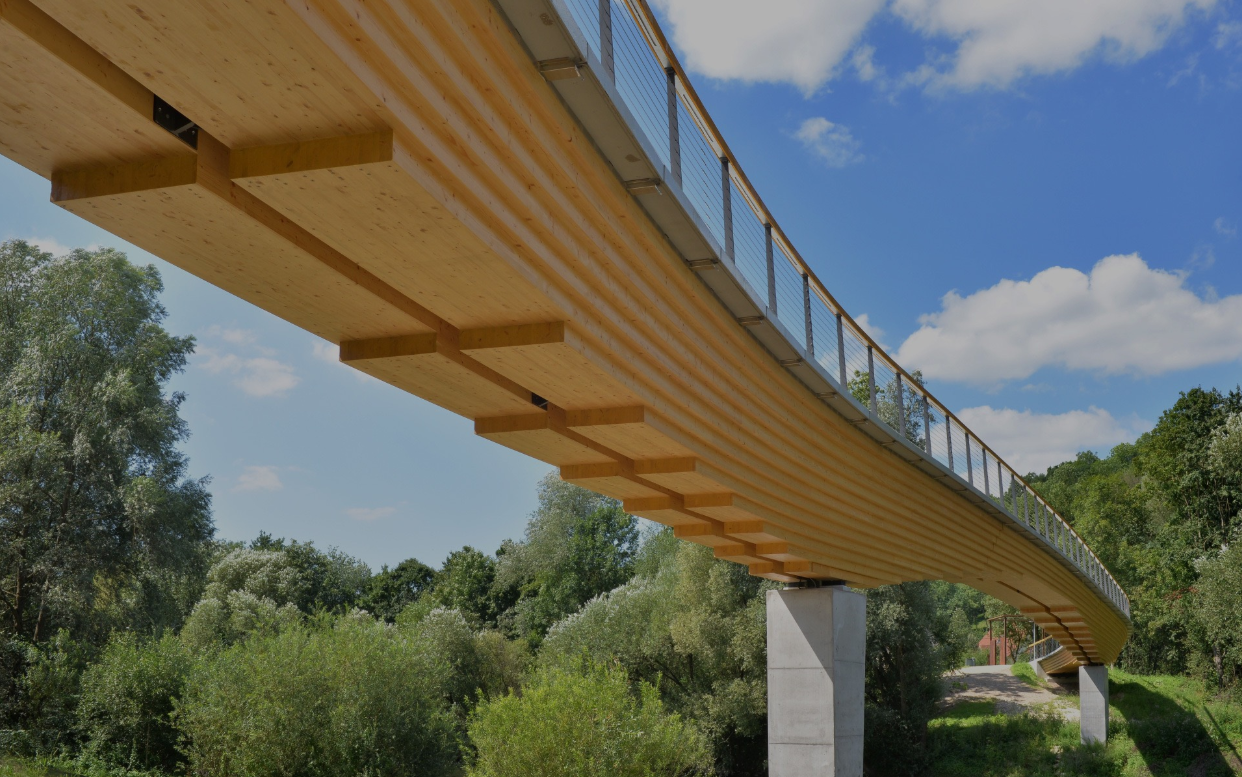
Figure 1: A modern pedestrian bridge in Neckartenzlingen uses a gracefully curved glulam timber arch as its main span, demonstrating how GLT can replace steel or concrete in long-span structures. The wood is left exposed, highlighting its natural aesthetic even in an urban infrastructure setting.
Key benefits of GLT
TBC
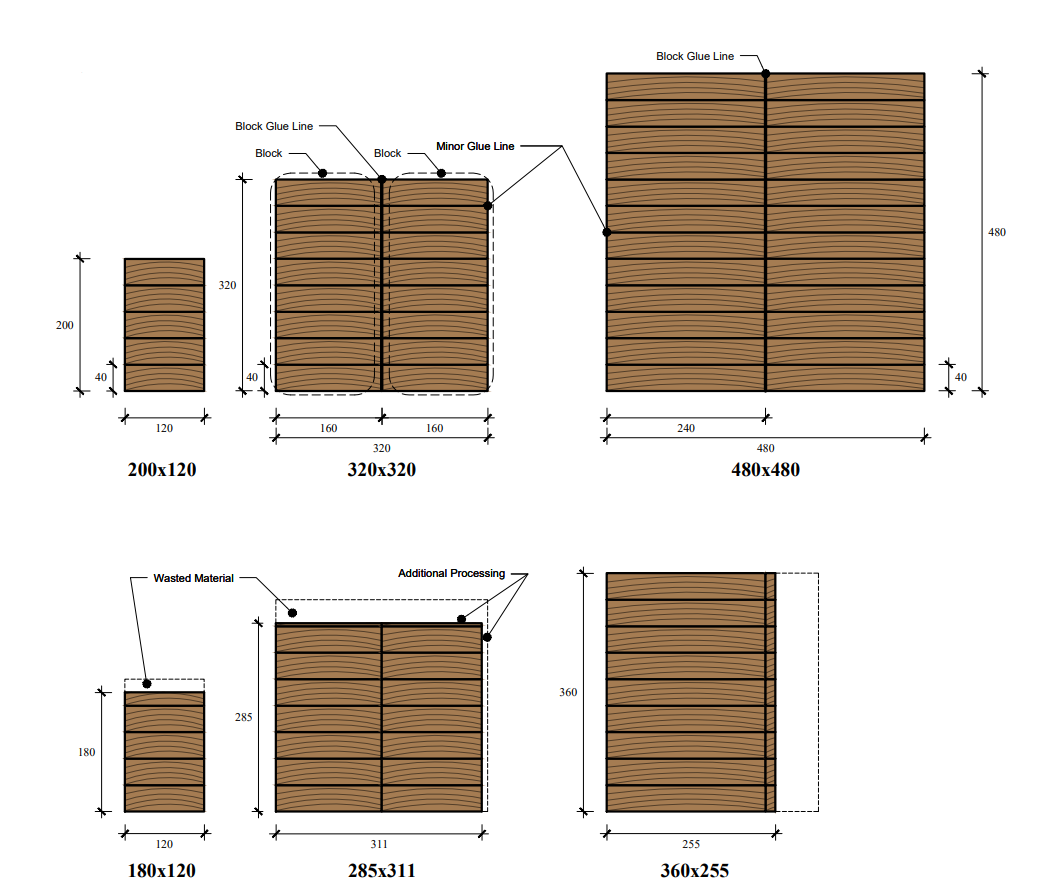
GLT is a type of structural engineered wood product made by bonding together multiple layers of dimensioned timber with durable adhesives. Crucially, all the wood layers (called laminations or lamella) have their grain running parallel to the length of the member. In essence, GLT uses many smaller planks that are glued together to form a beam or column.
Figure 2: GLT made up from small timber pieces, and encapsulated in a resilient/stronger/aesthetic species of timber
This technique produces a component that is stronger and more reliable than an equivalently sized piece of solid sawn timber because the manufacturing process removes natural weaknesses and allows for much larger sizes than can be found in nature. A well-designed glulam element can achieve impressively high strength and stiffness, with some species and configurations exceeding bending and compression capacities of 50MPa, higher than high-strength concrete mixes. This allows engineering timber to be used in structural spans that would be impossible using solid sawn timber.
Wood is hygroscopic, and experiences dimensional changes as it absorbs water from the atmosphere. The composition of timber elements into glulam significantly reduces the dimensional changes of the overall element.
It’s helpful to distinguish GLT from other popular mass timber materials.
GLT can be used to create long stable spans and elegant shapes in wood, such as heavy timber beams, roof rafters, floor girders, columns, and portal frames. It can also be used to create the soaring arches and trusses of churches, vaulted hall roofs, or airport terminals. Its capacity to be fabricated in curved forms also means designers can achieve dramatic arched ceilings or wave-like rooflines that would be difficult with steel but are relatively simple with laminated wood.
In modern mass timber buildings glulam beams and columns typically the vertical loads, often paired with CLT panels for floors and walls. Beyond buildings, GLT is also used in bridges, pavilions, and can also be used in outdoor structures like highway bridges and long-span footbridges.
In smaller scale projects GLT can be hidden as a header above a wide window opening, or exposed as a decorative and structural element in a home’s main room. GLT beams can also be used for garage door headers, floor beams, or ridge beams, taking advantage of their superior strength in a compact size.
Its capacity to be fabricated in curved forms also means designers can achieve dramatic arched ceilings or wave-like rooflines that would be difficult with steel but are relatively simple with laminated wood.
Figure 3: Curved GLT during fabrication, and in application as a bridge beam Source
(The introduction image of a pedestrian bridge arch is a great example of a curved glulam member in action.) In modern mass timber buildings, you’ll typically find glulam beams and columns carrying the vertical loads, often paired with CLT panels for floors and walls: a combination that plays to each product’s strengths. Beyond buildings, GLT is used in bridges, pavilions, and canopies as well, proving its mettle in heavy-duty outdoor structures like highway bridges and long-span footbridges.
Figure 4: GLT pedestrian bridge. Source
GLT was first used in the 1800s, when woodworkers and builders began experimenting with laminated wood beams. One of the earliest surviving examples of laminated timber roofs was built for the King Edward VI College in Southampton, England. These early beams were glued from smaller timber pieces, though the adhesives of the time (often natural glues) were far from perfect. The first recorded building made with what we now consider glulam was an auditorium in Basel, Switzerland, constructed in 1893. This GLT frame used early adhesives that were not waterproof, meaning those pioneering glulam beams had to stay in dry conditions to avoid delamination. Despite such limitations, these 19th-century projects proved the concept that small wood boards could be bonded into strong, single structural members capable of supporting large spans.
At the turn of the 20th century, European engineers refined glulam construction and set the stage for its worldwide adoption. Otto Karl Friedrich Hetzer, a German carpenter and inventor, was a key figure, obtaining a patent in 1901 for a method of gluing together straight wooden beams from multiple laminations. He soon pushed the idea further, patenting a technique for creating curved glulam arches, opening up exciting possibilities for architecture. Structures built with the patented “Hetzer System” sprang up across Europe in the early 1900s.
Other engineers and organisations licensed Hetzer’s approach, and by 1922 glulam construction had been used in at least 14 countries. Builders were attracted to glulam because it could produce long-span roofs and arches that solid timber alone could not achieve, all while making economical use of smaller-dimension timber members. However, early glulam elements were still assembled with relatively basic glues, so they occasionally had problems with durability. It wasn’t until decades later that weatherproof bonding resins became available.
Figure 5: Construction process of the girders in Niederurnen in 1912
In 1934, glulam was introduced into the United States. In that year, German-born engineer Max Hanisch designed a new school gymnasium in Peshtigo, Wisconsin, using glulam arches – notably, this became the very first U.S. building constructed with structural glued laminated timber.
Figure 6: Interior of the school gymnasium in Peshtigo, Wisconsin, built in 1934. It remains in service today.
Local officials were initially sceptical of the novel glued-wood beams, with authorities refusing to approve the arched roof until the builders added extra bolts and metal straps as a safety precaution. Fortunately, engineers from the United States Forest Products Laboratory (FPL) helped test and validate the design. The completed Peshtigo gym proved a success, and load tests demonstrated that the glued timber arches were extremely strong, and also more fire-resistant than steel beams under comparable conditions.
Subsequently, glulam quickly gained momentum in the U.S. and abroad. During World War II, steel was scarce, and the military needed large structures like aircraft hangars and warehouses, so engineers turned to glulam for long-span trusses and frames. In 1942, a fully water-resistant (phenol-resorcinol) adhesive was introduced, finally making it possible to use glulam reliably in exterior and high-moisture environments. No longer limited to dry indoor settings, glued laminated timber could now compete with steel or concrete in bridges and outdoor roofs. By the early 1950s, glulam had entered the construction mainstream, with at least a dozen manufacturers across North America. In 1952, these manufacturers banded together to form the American Institute of Timber Construction (AITC), a trade association dedicated to establishing industry standards and promoting the use of structural glued timber. The first national structural glulam standards followed in 1963, which gave architects and builders confidence that engineered wood beams would perform consistently.
In the decades that followed, glued laminated timber was used in increasingly ambitious ways. For example, in 1966 the Keystone Wye interchange in South Dakota featured two highway bridges made from towering glulam arches in a bold showcase of wood engineering on a public roadway. It remains in service today.
Figure 7: Keystone Why interchange South Dakota
By the late 20th century, glulam had spread worldwide and evolved into a trusted material for use in schools, churches, sports facilities, and high-rise buildings. As building codes and engineering knowledge developed, designers grew more comfortable using glulam for structural frames.
Glulam is experiencing a renaissance as part of the push for sustainable construction. Modern engineers now pair glulam with other engineered woods like CLT to build entire buildings efficiently with wood.
GLT is an engineered wood product made by bonding together multiple layers of dimensional timber with durable adhesives. The wood grain in GLT runs in the same direction along the member, giving it high strength along its length. GLT can be manufactured in straight beams or curved arches, and in impressively large sizes typically limited by transport or other logistical constraints. Below is a brief overview of the main steps in the GLT manufacturing process.
This process is not unique to GLT, and is the standard procedure for sourcing timber and transforming it into a usable, dressed product for any application. It begins with sourcing quality timber from sustainably managed forests, usually plantation softwood species like spruce, pine, or fir. These sawn boards are kiln-dried to about 12 per cent moisture content to ensure compatibility with the adhesives and to minimise shrinkage. Dry timber is critical because matching the wood’s moisture to expected in-service conditions prevents the glued timber from warping or shrinking as the member reaches equilibrium moisture content with its environment after installation. Each piece is then planed smooth and graded, either visually or by machine, for its structural properties.
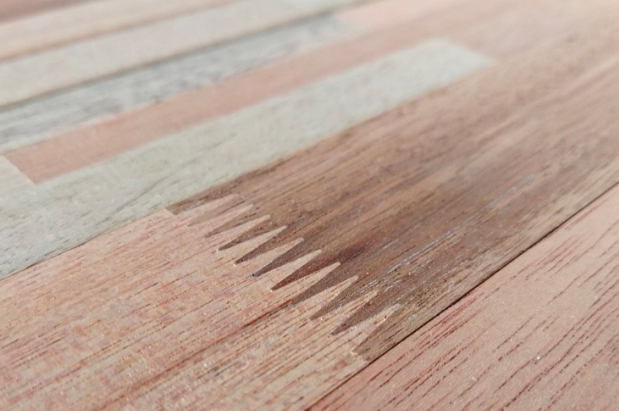
To make members longer than the source trees, manufacturers join shorter boards end-to-end using finger joints: a zig-zagged seam cut into the ends of timber pieces. The profile maximises surface area for gluing and creates a strong bond. Structural adhesive is applied to the interlocking “fingers”, and the pieces are pressed together to cure. This process yields continuous laminations, also known as lamella, of the desired length. Finger-jointing allows continuous laminations far longer than individual sawn boards, meaning glulam beams can span great distances uninterrupted.
Figure 8: Close-up of a finger joint in wood. Finger joints allow shorter lumber pieces to be glued end-to-end, creating long, continuous laminations for GLT beams. This greatly extends the length of timber elements beyond natural tree sizes (Photo: Santeri Viinamäki, CC BY-SA 4.0).
Once the laminations are prepared to the desired sizes, the lay-up of the member is assembled. Each lamination is coated with a structural, moisture-resistant adhesive on its wide face. The boards are then stacked together in the required orientation, with all grains running parallel. The layering order can be tuned, for example, specific grades or wood species might be placed in certain positions for structural or appearance reasons. For a straight member, the laminations are stacked flat on top of each other in a straight line; for a curved member, the laminations are placed into a curved form or jig that follows the desired bend. Modern adhesives used in glulam form bonds stronger than the inherent tensile strength of the wood itself, and they ensure the member can perform in humid or even exterior conditions.
Figure 9: A particularly large GLT member during fabrication
The stack of glue-coated boards is pressed together under high pressure to squeeze the layers tightly while the adhesive cures. Manufacturers use large hydraulic, vacuum or mechanical presses to apply uniform pressure along the entire member, ensuring a solid bond. If the beam is curved, the press and form hold the curvature until the glue sets. The assembly is kept clamped as the adhesive hardens, often between 6-16 hours at room temperature. Some facilities use controlled heat or radio-frequency curing to accelerate this process. At this stage, the GLT member has its basic shape and size fixed.
The faces of the beam are planed or sanded to remove any excess dried glue that has squeezed out and to make the surfaces smooth and uniform. The beam is then fabricated to final specifications: this can include trimming it to exact length and cutting any required details such as slots, notches, or holes for connections. Modern factories commonly employ Computer Numerical Control (CNC) machinery for this stage, allowing reliable integration with digital building designs. CNC routers and drills can precision-cut complex shapes, connection slots, and bolt holes with high accuracy. As a result architects and engineers can design intricate connections (for example, steel knife plates, rods, or custom steel hardware), and the glulam can be delivered with all those holes and recesses pre-cut perfectly in the right locations. Such prefabrication ensures that pieces fit exactly on-site and reduces the need for field cutting, however great care must be taken to specify machining that is both possible and within the capacity of the available machinery or manual skillets. After machining, protective finishes may be applied: for example, glulam that will be exposed outdoors can be factory-coated with sealants or even pressure-treated for durability. Finally, the completed GLT elements are wrapped to keep them clean and dry, then shipped out to the construction site ready for installation.
Figure 10: GLT members wrapped during logistics, prior to installation. It is important to protect members from moisture fluctuations and from direct wetting
Understanding the basics of how GLT is made can help designers make better decisions. Designers should be aware of the capabilities of manufacturers (e.g. maximum cross-section dimensions or transport limitations) when planning projects, and consider surface finish and connection details early so they can be incorporated during fabrication. Modern innovations like improved adhesives, automation, and CNC machining mean that today’s GLT components are high-quality, prefabricated elements delivered to the site with precise dimensions and ready for assembly.
For those interested in knowing more about GLT production and standards, Australian-specific resources are available. The industry in Australia is governed by standards such as AS/NZS 1328.1 - Glued Laminated Structural Timber, which sets out the performance requirements and minimum production (manufacturing) standards for structural glulam, along with related standards like AS 5068 that cover finger-jointed structural timber components used in glulam. Further detailed guidance can be found in technical publications and guides from organisations like the Engineered Wood Products Association of Australasia (EWPAA) and the Glued Laminated Timber Association of Australia (GLTAA), who provide comprehensive information and certification programs covering glulam manufacturing processes, grading rules, and design practices. These resources delve into the nitty-gritty of adhesive bonding techniques, structural strength testing, and ensuring code compliance under Australian building codes.
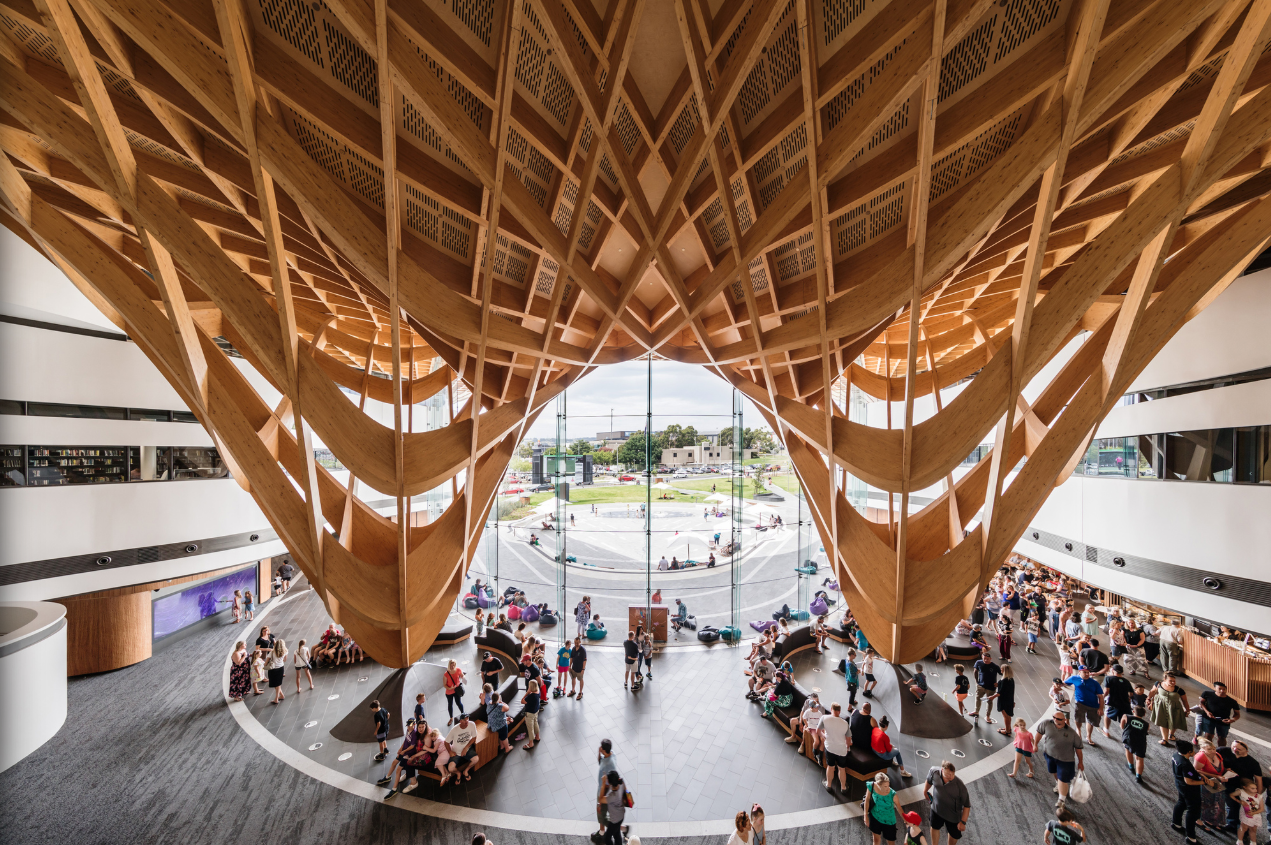
Figure 11: Glulam beams creating a spacious interior forming the roof structure.
GLT can be used to create expansive, open areas with a warm natural look and offers a unique mix of performance, sustainability, and aesthetics in modern construction. Here are the main benefits of GLT.
GLT beams boast an exceptional strength-to-weight ratio. By engineering out the natural defects of wood, glulam can support very heavy loads and span long distances with minimal deflection. For example, wide-span roofs in arenas and halls commonly use glulam to create broad open spaces with minimal columns. GLT has been used for large structures like long-span bridges and vaulted roofs, demonstrating that its span is limited more by transportation logistics than by the material itself.
A GLT beam weighs significantly less than an equivalent steel or concrete beam. This reduction in weight can translate to smaller foundations, and simpler transport and erection. GLT members can often be lifted into place with lighter cranes. The lightweight nature of wood also means lower seismic loads in earthquake-prone areas, as a lighter building enacts less force through its connections and foundations during a quake.
GLT is relatively simple to work with on site. Unlike steel, timber can be cut, drilled, and connected using common tools. If necessary, builders can modify glulam members on-site, and carpenters can nail or screw into glulam as needed for fittings or attachments, although most projects are planned so that no on-site adjustments are necessary. GLT’s lighter weight and workability make installation faster and more predictable.
GLT brings the warmth of wood into large-scale construction. The natural wood grain can be left exposed, turning structural elements into beautiful architectural features. Architects often choose glulam because of the natural warmth and beauty it brings. Wood has a tactile, biophilic appeal: exposed timber beams can make even large modern buildings feel more inviting and human. GLT takes the beauty of wood and enhances it, allowing for clean, architecturally refined applications with minimal defects. Manufacturers offer glulam in different appearance grades so designers can specify high-quality finishes for exposed members where this is important. The result is that GLT structural elements often double as finished design features.
Figure 12: Curved glulam timber arches during construction
It may seem counterintuitive, but mass timber elements like glulam perform very well in fire events. While wood is a combustible material, large glulam members have a natural fire-resistance mechanism - they char on the outside at a slow, predictable rate, which insulates the core of the beam. The outer char layer limits oxygen to the interior wood and slows heat penetration. Because of this, an appropriately sized glulam beam can retain its structural integrity for a surprisingly long duration in a fire. Surprisingly, unprotected steel often fails sooner than glulam in severe fire conditions - steel heats up quickly and can bend or collapse when the temperature gets sufficiently high, whereas a glulam beam will typically continue to carry load as its core, insulated from the heat by the timber and char around it.
Building codes recognise this performance by allowing exposed timber in many applications, as long as the members are sized to accommodate a calculated char depth. This predictability is a significant advantage and means glulam can satisfy fire performance requirements. This can be further augmented with coverings or other finishes if required.
Figure 13: GLT used, exposed, in a fire station
Wood is a renewable resource, and engineered wood products like glulam optimise the use of forest materials by using smaller-diameter timber efficiently.
Producing glulam requires far less energy and results in a much lower carbon footprint – so-called ‘embodied carbon’ – compared to the production of steel or concrete.
Additionally, GLT stores carbon – about half of the dry weight of GLT is carbon, so-called ‘biogenic carbon’ – that has been removed from the atmosphere during the growth phase, which is then stored for the life of the building.
GLT’s light weight can reduce the amount of material needed in foundations and other supporting elements. Many green building rating systems (e.g. LEED or Green Star) reward the use of certified wood and low-carbon materials.
Wood has natural insulating properties, which means exposed timber elements can help with thermal performance by reducing thermal bridging, hence GLT not only reduces embodied carbon but can also improve operational energy efficiency over a building’s life.
As long as the timber comes from sustainably managed forests, which most modern suppliers ensure through certifications, using glulam helps support renewable forestry rather than depleting resources.
GLT is a robust and versatile material, but it does have some practical limitations that designers should bear in mind. These include considerations such as cost, availability, moisture effects, member size, connections, maintenance, and building code constraints. By understanding these issues and planning for them, it is possible to embrace glulam’s benefits while avoiding common pitfalls. Below we outline key limitations of GLT and some suggested tips to mitigate them.
Glulam members can have a higher upfront cost compared to some conventional materials. Custom shapes or non-standard sizes may further increase costs due to special fabrication. Despite these higher initial costs, it’s important to understand that glulam’s other attributes can help to reduce costs elsewhere (e.g. lighter foundations or transport costs), and faster installation can offset higher initial costs in many cases.
Mitigation: Plan the budget early and consider using standard glulam sizes or profiles to take advantage of economies of scale that are often associated with standardisation. Engage local glulam suppliers or fabricators early for pricing and lead time estimates, and explore hybrid designs to control overall cost.
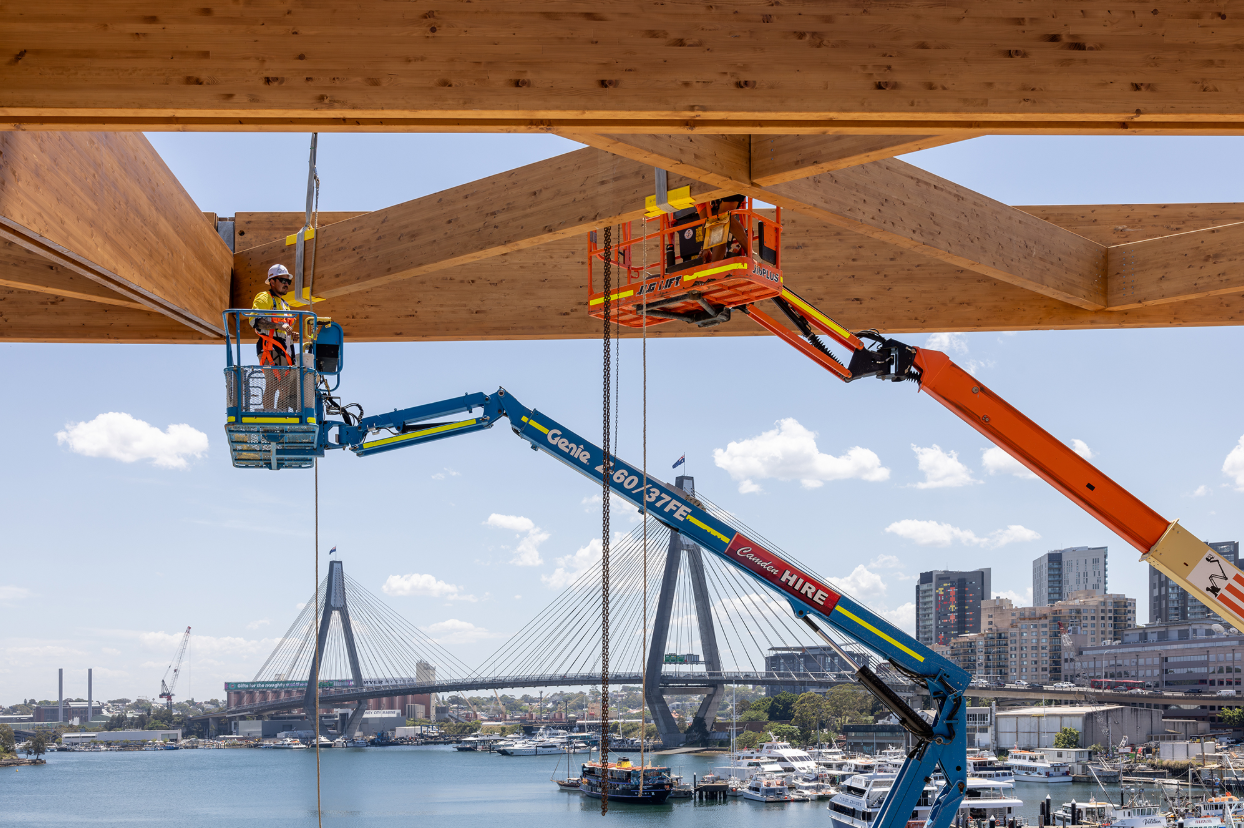
Because GLT is typically manufactured to order, it is typically supplied on a project by project. The supply chain can also be sensitive to market fluctuations and transportation logistics. For example, glulam can be produced in very long lengths (over 40 m), but transport regulations will likely limit the maximum member length that can be delivered to site. A good example of this is the Sydney Fish Markets, which delivered elements from Europe by boat, installed directly from a barge in Sydney harbour. By avoiding road transport, larger elements could be economically transported to site.
Figure 14: Sydney Fish Market beam being installed
Similarly, very large cross-sections or unusual species selection may require splicing multiple pieces or ordering from specialized mills.
Mitigation: Coordinate with manufacturers early in the design phase to understand lead times and size limits. Whenever possible, design using standard beam sizes that local producers offer, and allow some flexibility in the design in case a certain stock size is more readily available. Plan for shipping and handling of long members. It may be necessary to design splices or use modular construction if transportation of singular beams isn’t feasible. By designing early, ordering well in advance and communicating with suppliers, it is possible to avoid delays and ensure the glulam elements arrive when needed.
Wood’s relationship with moisture is a crucial consideration for glulam. Modern glulam is produced using durable adhesives that are water-resistant, however the wood itself is still susceptible to moisture-related effects. If glulam members are repeatedly soaked and dried (as in an exposed bridge or canopy), their strength can decrease significantly over time. Moreover, as a wood product, glulam can be vulnerable to decay (rot) or attack by insects if it is in a persistently damp environment without protection. Even in normal conditions, changes in humidity cause glulam to gain or lose moisture, which can lead to seasonal checking (small cracks) as the timber dries and shrinks. These cracks are usually cosmetic and don’t affect structural capacity, but they can trap water if left unprotected.
Figure 15: An exterior highway bridge in the Netherlands built with acetylated glulam (Accoya® wood) to improve moisture resistance. Using naturally durable or chemically treated timber for glulam can mitigate decay and swelling in wet climates. In design, incorporating features like roof overhangs and flashing will further shield glulam from rain.
Mitigation: Protect glulam from direct exposure whenever possible. Design deep eaves, canopies, or cladding to keep rain and sun off the beams. If glulam must be exposed, consider specifying pressure-treated or naturally durable wood species for the laminations, or even acetylated wood, which greatly improves rot resistance. All exposed surfaces should be sealed with a quality exterior wood finish; end-grain sealants are critical on any cuts to prevent absorption. Good detailing will certainly help, for example ensure all geometries can shed water by providing metal flashing or caps on the tops of outdoor beams, and avoid any flat ledges or pockets where water can collect. Also, ensure connections are detailed to avoid trapping water (use washers, stand-offs, drainage holes) and expect some drying cracks in larger members. These can be filled with elastomeric wood filler for appearance if needed, and regular maintenance of the finish will limit their development. Lastly, when building is enclosed, try to avoid using the HVAC system. The timber will have reached equilibrium moisture content with the external environment, and bringing it down to the moisture content of an interior environment should take some time. Drying out the surfaces of elements without allowing sufficient time for moisture to be drawn from the elements is likely to induce surface cracking.
Small shrinkage cracks (checking) visible in a glulam beam as it dries. Such checking is common in large timber sections and is mostly an aesthetic issue, not a structural failure. Proper sealing and gradual drying can minimize crack size, and cracked surfaces can be refinished or filled if appearance is a concern.
Glulam enables long spans and large dimensions that would be impractical with solid wood. In most situations a glulam beam or column usually needs a greater cross-sectional area to support a given load compared to a steel member. This increased depth can impact floor-to-floor heights or require careful architectural integration. Compared to reinforced concrete, glulam member sizes can be similar or slightly larger depending on the design loads, so while glulam competes well with concrete spans, it’s likely that sizable timber elements will be required. There are practical limits to what can be transported – issues such as highway clearances or escort vehicles will usually constrain the size of a single member that can be delivered to site.
Mitigation: When planning a glulam structure, be conscious of member sizing early. Ensure that the building layout can accommodate the necessary beam depths. For example, it might be necessary to integrate deeper beams into the roof or floor thickness, or express them as an architectural feature. Where possible, try to incorporate sizes that are commonly available - many manufacturers have stock beam sizes that are cost-effective and more readily available. If heroic spans or dimensions are required, it may be necessary to splice glulam elements on site (with internal steel plates or scarf joints) or redesign the structural scheme (e.g. add an intermediate support) to stay within transportable sizes. Be sure to check early with suppliers on the maximum section sizes and lengths that can be transported to site.
Connections in glulam structures often require input from structural engineers familiar with the material. Good engineering will ensure that the strength of the timber and embedded connection will endure, and minimise the likelihood of connection loosening, or allowing condensation or water to accumulate inside a hidden connection.
Mitigation: Suppliers, fabricators and engineers have developed guidelines and hardware to make glulam connections reliable. It is important to follow proven best practices for timber connections. For example, try to transfer loads in bearing (compression) or along the grain rather than relying on screws or bolts in tension whenever possible. Avoid notching or cutting into beams in high-stress zones. Use concealed connectors or knife plates that can be engineered to carry the load without splitting the wood. Many modern connector systems exist specifically for glulam. If through-bolts or lag screws are used, ensure they are placed with sufficient edge distance and preferably in pre-drilled holes to prevent splitting. It’s often better to use multiple smaller fasteners rather than one large bolt, spreading the load out and enhancing redundancy.
Critically, it is important to design the connection to allow the wood to breathe and move, for example design slot holes to accommodate slight shrinkage, and leave gaps or use slotted plates so that the wood isn’t locked in place as it dries. Protect against moisture by using metal caps, gutters, or ventilation around connection points – for example, raise beam ends off concrete with a steel shoe, and avoid burying steel plates deep inside wood in wet locations. By collaborating with an experienced timber engineer or using manufacturer-supplied connection details, it is possible to achieve joints that are both strong and durable.
Timber can be low maintenance in normal service, but it is never zero-maintenance. When glulam is exposed or if it’s part of an exterior structure, it is important to plan for some routine maintenance to ensure longevity and appearance. The wood surface can gradually weather, much like any wood siding or deck would. Without protection, UV exposure will grey the wood, and moisture can raise the grain or cause surface mildew. Additionally, any protective finishes applied to glulam (stains, sealers, paints) will have a finite service life and require reapplication. It will be necessary to check the glulam for signs of rot, insect attack, or excessive cracking, though these are unlikely if the wood has been properly detailed and protected. Glulam isn’t a “set and forget” solution – in the same way that steel needs paint touch-ups and concrete needs sealers, timber structures will require appropriate ongoing maintenance.
Mitigation: It’s important to to plan a maintenance schedule, just as would be the case for other building elements. If the glulam is indoors and climate-controlled, maintenance might simply be periodic visual inspections (checking that connections remain tight, no leaks are affecting the wood, etc.). For exposed or exterior glulam, apply a high-quality outdoor wood finish or stain and reapply it at periodic intervals as per product recommendations. Manufacturers often offer factory-applied primer or sealer on glulam, usually as temporary protection during construction, so a finish coat is needed after installation. Ensure that any glulam is stored properly during construction (i.e. covered, off the ground) and any field cuts are sealed promptly to avoid early damage. Once in service, look for cracks or checks that could collect water; if they’re large and in a wetted location, consider filling them or refinishing the beam to reseal the surface. Also inspect connection areas for any rust or moisture ingress, and ensure flashings and caulking around the timber are intact. By designing for easy access (for example, using a lift or catwalk to reach roof beams) and budgeting for maintenance in the long term will significantly extend the life of a glulam structure.
GLT is used in a diverse range of building applications, from everyday homes to record-breaking structures. Thanks to its strength, versatility, and natural beauty, GLT can be used for a variety of functions, including beams, columns, arches, portal frames, and entire structural systems. The following are typical and innovative applications of GLT across different building types, highlighting how designers leverage glulam for both its structural performance and aesthetic warmth.
Figure 16: The Wave sports hall in Singapore features a 72 m span glulam arch roof, demonstrating GLT’s ability to create vast column-free spaces. Designed by Toyo Ito, it is one of Asia’s largest timber roof structures.
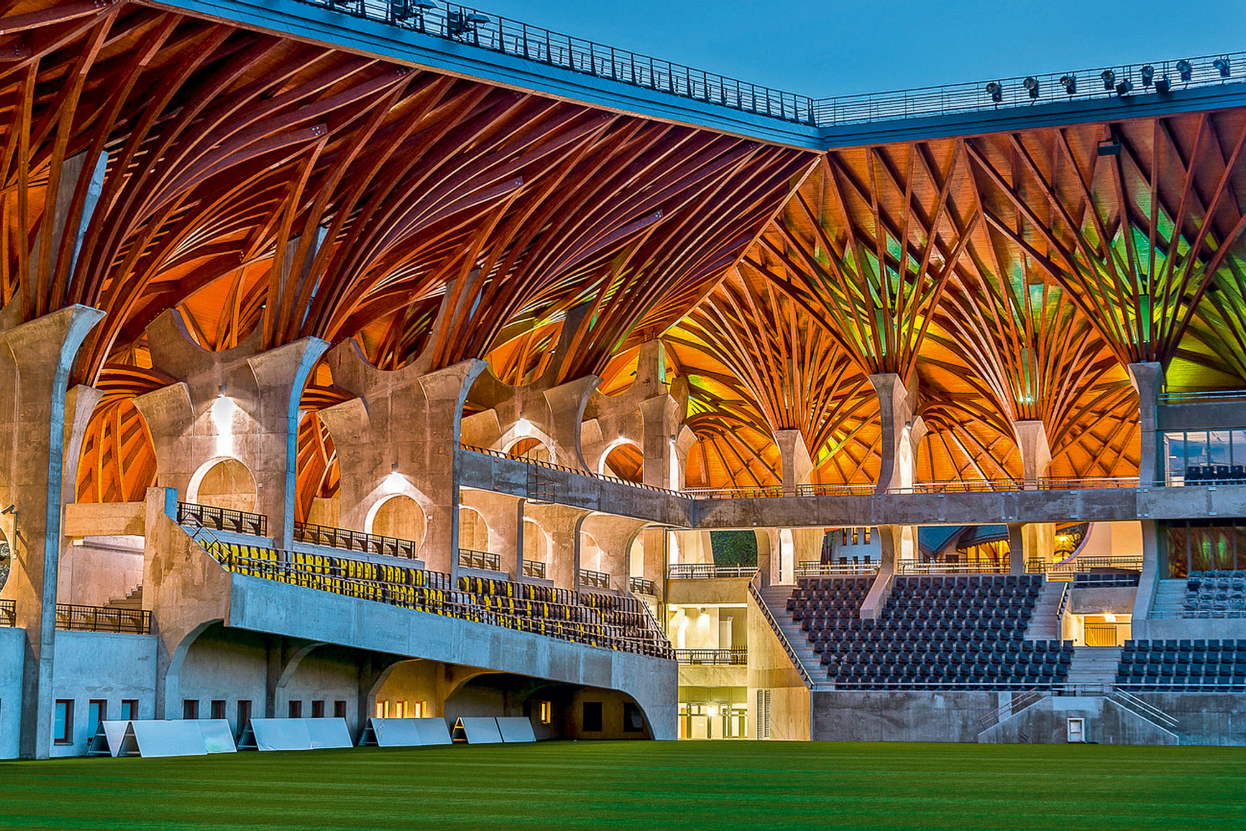
One of the most celebrated uses of glulam is in long-span roofs for sports arenas, exhibition halls, and airport terminals. Curved GLT arches and trusses can span many tens of metres, creating open-plan halls ideal for athletics or events. Such structures showcase how GLT can replace steel in large roofs, achieving soaring, open interiors with a warm timber character. Glulam portal frames are also common in gyms and community halls, providing increased headroom throughout wide spaces, which can provide unobstructed indoor courts or assembly areas. Designers often take advantage of glulam’s ability to be curved or cambered, crafting elegant arched profiles that follow the flow of forces, ideal for creating dramatic roof forms.
The Elephant House at Cologne Zoo in Germany is a striking example - its roof is composed of seven leaf-shaped glulam “umbrellas” up to 25 m across, each formed by curved timber beams with tension and compression rings.
Figure 17: These long-span applications exploit GLT’s high strength-to-weight ratio. From vaulted church roofs to modern stadiums, GLT has proven ideal for wide-span structures where designers want both performance and biophilic beauty.
Community centres, libraries, schools, and places of worship increasingly incorporate glulam to create inviting and expressive spaces. GLT post-and-beam systems lend a warm, natural feel to civic buildings while providing robust structure. It can be is ideal for open, inclusive spaces like community halls, since the exposed wood structure adds visual warmth and a comforting atmosphere.
The Cathedral of Christ the Light in California features a soaring interior formed by glulam ribs. Its 36,000 square foot space-frame skeleton of glulam beams and steel rods rises in a sweeping curve, encased by a glass skin. This modern cathedral echoes the grand timber vaults of historic churches but uses contemporary engineered wood to achieve its 34 m height.
Figure 18: This modern cathedral echoes the grand timber vaults of historic churches but uses contemporary engineered wood to achieve its 34 m height.
These projects show how GLT can combine structure and sculpture, allowing architects to realise bold forms. From community recreation centres to art galleries, glulam’s adaptability in shape and finish makes it a top choice when a building’s structure is meant to be seen and celebrated.
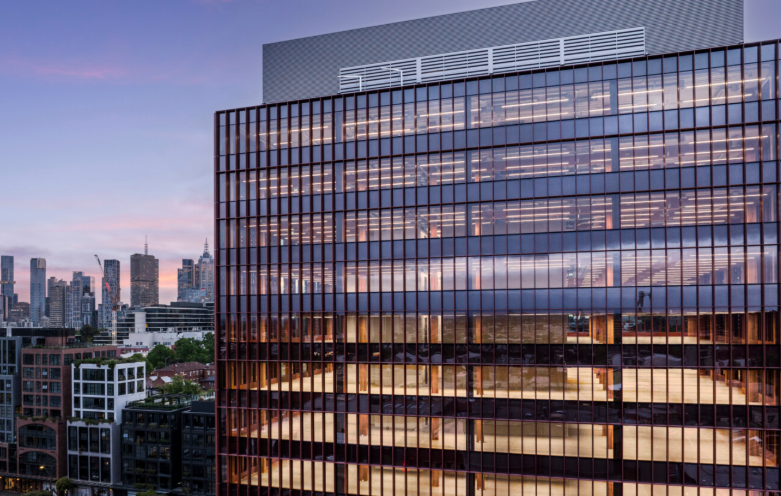
Glulam is not limited to low-rise installations; it’s also being increasingly used in multi-story commercial buildings. Modern offices and retail buildings use GLT for their structural frames, achieving open floor plans and sustainable credentials. An excellent example is the Tamedia Office Building in Zurich, a seven-story office headquarters built entirely with an exposed glulam post-and-beam frame.
Figure 19: The massive spruce glulam columns and beams are precision-crafted and fitted without metal fasteners, demonstrating how glulam frames can handle the loads of mid-rise construction.
Behind a glass façade, the building’s timber structure is a fully visible showcase of engineered timber in an urban office setting. The building’s success proved that glulam frames can compete with concrete or steel for medium-rise structures, all while providing a distinctive interior aesthetic and biophilic environment for its occupants.
In retail complexes and shopping centres, glulam beams often span large atriums or form decorative roof geometry, such as curved rafters in a mall or supermarket. Glulam’s ability to carry heavy loads is leveraged for wide storefront openings and atrium roofs that flood spaces with light.
Engineered timber has also been used in the construction of bridges and civil infrastructure. GLT beams and trusses can form the main spans of pedestrian bridges and vehicle bridges, offering a lightweight, corrosion-resistant alternative to steel. Notably, the world’s longest timber bridge is the Vihantasalmi Bridge in Finland, stretching 168m. It carries a highway with GLT girders up to 42 m long.
Figure 20: GLT Bridge
Typically, glulam bridge designs use either girder spans or arch/truss forms. Curved glulam arches are popular for pedestrian bridges or signature footbridges, lending an elegant natural look that blends into landscapes. Glulam bridges benefit from wood’s high strength-to-weight ratio and natural flexibility, which is advantageous under dynamic loads. Additionally, large GLT members that are able to resist salt corrosion provide a surprising level of durability for outdoor use. Bridge engineers often combine glulam with steel in connections or tension elements, blending materials for optimal performance. As a result, glulam has been used in footbridges, road bridges, cycle bridges, large roof canopies over highways, and even as architectural noise barriers along roads.
In residential construction, glulam has long been to solve design problems and provide aesthetic enhancement. Many homes use glulam beams to achieve open-plan layouts. Exposed timber beams also add charm and character to a house; a polished glulam beam spanning a vaulted ceiling becomes a focal point that celebrates craftsmanship.
Glulam also appears in small-scale structures like pergolas, carports, cabins, and home extensions. Its ability to be custom fabricated to almost any curvature or length is ideal for bespoke residential designs. In multi-family residential buildings (e.g. apartments and townhouses), glulam posts and beams are often combined with CLT floor panels to form all-timber structural systems. From a simple backyard pavilion to a luxury wood-framed home, glulam brings both structural reliability and aesthetic charm to residential architecture. And, with a growing awareness in biophilic design, homeowners are choosing to leave glulam beams exposed in interiors to enjoy the natural wood textures in their daily living spaces.
GLT technology is continuously evolving, enabling structures once thought impossible. The pinnacle of innovative GLT application is in high-rise buildings and skyscrapers. Tall “plyscrapers” are now a reality thanks to glulam’s strength. When it was completed in 2019 Mjøstårnet in Brumunddal, Norway, an 18-story building standing at 85.4 m, was the tallest timber structure in the world. Mjøstårnet’s structural frame incorporates massive glulam columns and beams, with cross-laminated timber floor slabs and core walls, forming an all-timber high-rise that meets strict safety codes. This mixed-use tower demonstrates that glulam can carry the gravity loads of a tall building and work in tandem with concrete or steel (the elevator shafts use CLT and some steel bracing for seismic/wind). The success of Mjøstårnet has spurred many other proposals for timber towers around the globe.
Figure 21: Completed in 2019 Mjøstårnet in Brumunddal, Norway, an 18-story building standing at 85.4 m, was the tallest timber structure in the world. Its structure relies on glulam post-and-beam framing and CLT panels, proving that engineered wood can reach high-rise scale.
Other innovative projects include the Sara Kulturhus Centre in Sweden, a 20-story cultural centre built in 2021 with a glulam and CLT structure, and various office towers planned in Canada, Japan, and Australia that feature glulam beam-and-column skeletons. These projects often use hybrid timber construction: GLT beams and columns for the superstructure, combined with concrete cores or steel braces for extra stiffness and safety.
Figure 22: The Sara Kulturhus in Sweden
Other innovative projects include the Sara Kulturhus Centre in Sweden, a 20-story cultural centre built in 2021 with a glulam and CLT structure, and various office towers planned in Canada, Japan, and Australia that feature glulam beam-and-column skeletons. These projects often use hybrid timber construction: GLT beams and columns for the superstructure, combined with concrete cores or steel braces for extra stiffness and safety.
Beyond height records, GLT is enabling free-form and long-span structures that were once the domain of steel. Timber gridshells and complex curvilinear roofs often rely on arrays of glulam elements bent or assembled into flowing shapes.
Figure 23: Gridshell / Parasol GLT structures depend on parametric modelling and robust design documentation to create stunning structures
These cutting-edge applications benefit from digital fabrication: CNC machines can cut glulam into precise shapes or unique joints, opening possibilities for bespoke structures that fit together like a puzzle. From undulating roofs that mimic leaves or waves, to high-rise towers reaching for the sky, the applications of GLT continue to expand as designers experiment with its potential. Each project reinforces the notion that glued laminated timber is a true construction powerhouse, bringing together engineering performance, sustainability, and natural beauty in every application