
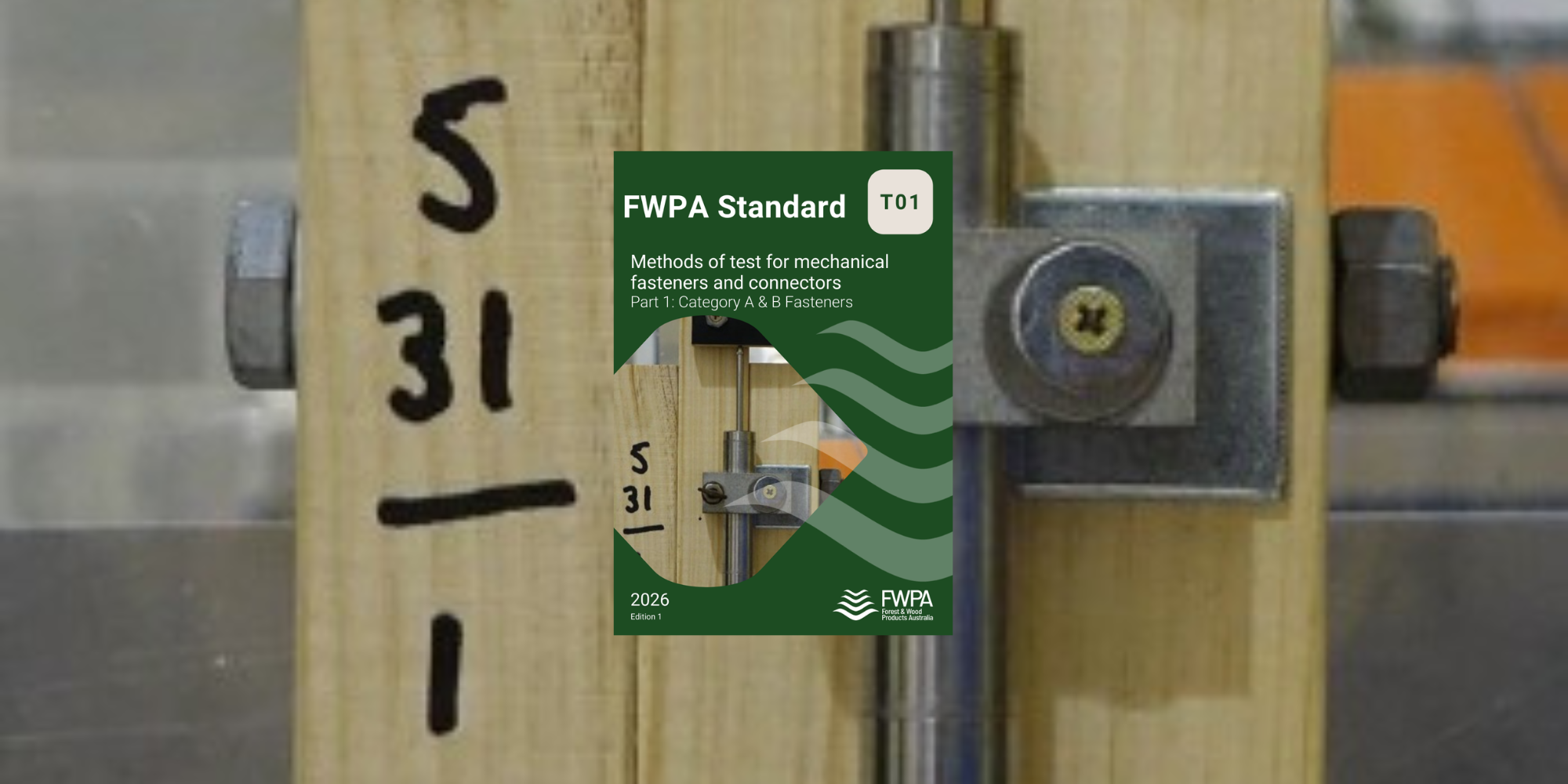

The Standard is intended for use by manufacturers, testing laboratories, universities, engineers and certifiers, and provides consistent methods for determining key connection properties including strength, stiffness, ductility and slip behaviour across sawn timber and engineered wood products such as GLT, LVL, CLT and plywood. It includes procedures for both lateral and axial loading scenarios, as well as testing of individual fasteners and full connection assemblies, enabling the generation of characteristic design values suitable for structural design under AS 1720.1.
Rather than replacing existing Australian Standards, FWPA Standard (T01) is intended to complement them by providing an alternative method for determining characteristic capacities of commonly used timber connection types until AS 1649 (2025) undergoes further comprehensive revision.
Industry benefits of FWPA Standard T01
- Quality assurance: Provides consistent and repeatable methods for testing timber connections, improving confidence in reported performance data.
- Improved design reliability: Supports the generation of robust characteristic values for use in structural design under AS 1720.1, strengthening engineering outcomes.
- Greater consistency: Establishes a unified approach to assessing connection behaviour across both sawn and engineered wood products.
- Support for innovation: Enables clearer performance data for modern timber systems, including mass timber and prefabricated construction.
- Enhanced industry confidence: Improves transparency and comparability of test results across laboratories, researchers and manufacturers.
- Practical industry application: Provides a usable framework for engineers, certifiers and product developers working with real-world connection systems.
- Complementary framework: Works alongside existing Australian Standards, supporting transition and ongoing improvement in timber testing methodologies.
- Research-backed development: Built on collaborative research between FWPA, industry and leading academic institutions, ensuring strong technical credibility.