

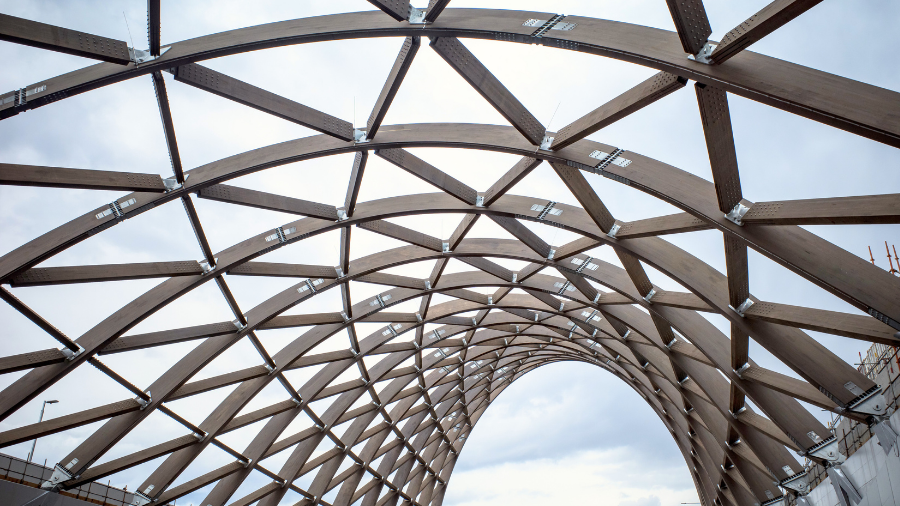
When the West Gate Tunnel Project opened, it introduced an unmistakable timber signature at the entrances: large glulam ‘net’ structures that frame the entries and exits. They operate as sculptural landmarks and as transitional light filters, easing driver adjustment to sudden changes in brightness as vehicles move in and out of the tunnel environments.
Attribution and project roles
This article acknowledges early concept and feasibility work undertaken by Timothy Allen and André Pereira from Taylor Thomson Whitting (TTW). The realised portal structures, including structural design development, manufacture, and international logistics, were delivered by Red Stag TimberLab, with full structural and geometric design services provided by CREATE under contract to Red Stag TimberLab.
Banner image photo credit: Kurt Cunningham
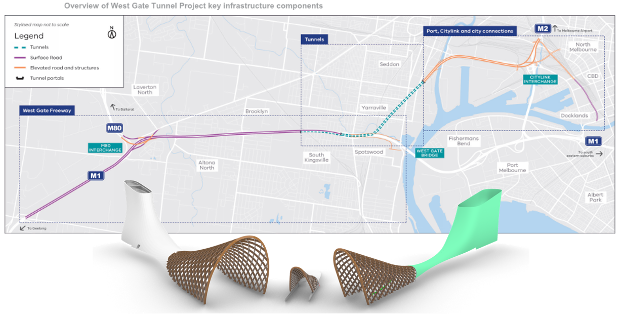
West Gate Tunnel Pair: Northern Portal, Southern Outbound.
Concept/feasibility reference design image (2023).
Source: Tim Allen, André Pereira Presentation June 2023.
Three portals, three geometries, one coherent family
As part of the delivery scope, Red Stag TimberLab was responsible for the structural design, manufacture, and international logistics of all three distinct net structures: North Portal, South Outbound, and South Inbound. Each structure varied in geometry and span, tailored to its specific tunnel interface and site condition.
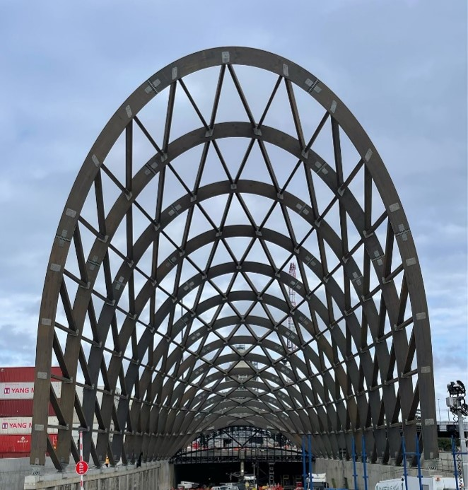
West Gate Tunnel Timber Net as experienced upon entry.
Source: Red Stag TimberLab.
The North Portal is the largest of the three, stretching 121 metres in length and rising up to 39 metres high to accommodate dual-direction traffic.
Big infrastructure tends to default to concrete and steel. The timber nets demonstrate a different proposition: timber deployed as a primary structural material, engineered to a scale and complexity that remains uncommon in Australian road projects.
Structural concept in plain terms
CREATE’s role on the project was to provide specialist timber design for the gateway structures, transforming the original architectural concept into a refined and buildable solution. The design features large timber arches combined with triangulated infill members, forming a distinctive lattice gateway for vehicles entering and exiting the tunnel.
The structures consist of large inclined glulam arches spanning the roadway, providing the primary lateral and vertical support. These arches are supported by a triangulated arrangement of glulam struts that tie the timber structure back to the tunnel structure. Infill struts provide longitudinal stability and additional in-plane shear stability through diaphragm action across the whole structure.
The arches are designed as fully continuous. Large moment splice connections allow multiple parts to be connected to form each arch, because the finished size and shape is too large for manufacturing or transport as a single element. The struts are treated as having pinned connections at each end where they meet the arches, and the arches are connected through pinned connections to the concrete supporting structure.
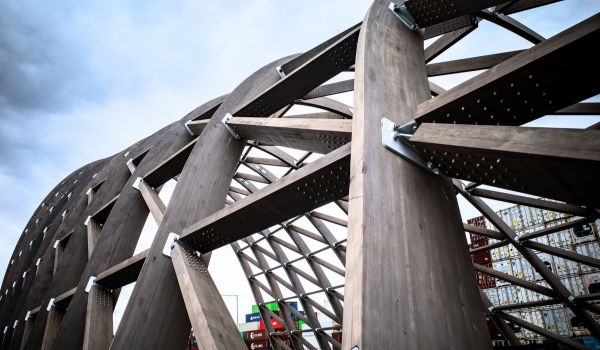
Source: Kurt Cunningham
Structural development and wind engineering
Each gateway structure is unique in geometry, scale and interfacing conditions with the surrounding tunnel and ventilation infrastructure. In the early stages of design, the focus was on defining performance requirements, assessing environmental conditions, and establishing key structural parameters and interface requirements. Red Stag TimberLab contracted CREATE Architects & Engineers to provide full structural and geometric design services, and CREATE worked with Red Stag throughout the many concepts and design schemes considered over several years during tendering and preconstruction phases.
Parametric modelling was used to optimise the arch geometry while addressing buildability constraints and alignment with surrounding infrastructure. The resulting structure behaves as a three-dimensional timber diagrid system (a triangulated lattice), where arching and diaphragm action provide stiffness and stability in both plan and elevation. As designs progressed, Red Stag and CREATE worked with the broader Australian project team to understand project requirements and complete analysis and calculations not only for the structures but also for interfacing and supporting structures in parallel.
Given the scale and exposure of the structures, wind loading was a governing design factor. Recognising the wind-dominant nature of the structures, Red Stag and CREATE collaborated with MEL Consultants to conduct wind tunnel testing using 3D-printed 1:200 scale models. The findings enabled precise structural calculations for both global and local wind pressures, informing resilient and refined design outcomes. Parametric modelling also helped develop efficient connection systems capable of transferring large forces while allowing the structure to be fabricated, transported and assembled adjacent to a live highway corridor.
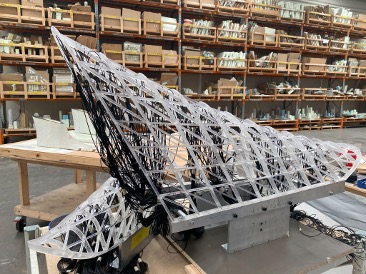
1:200 wind tunnel model wired for an analytic assessment. Source: Red Stag TimberLab.
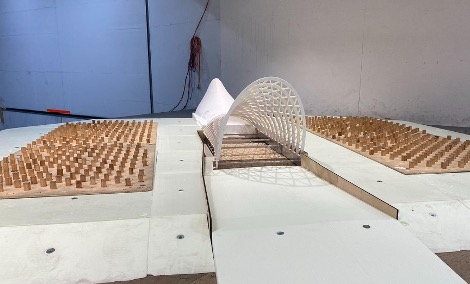
Scale model set within wind tunnel. Source: Red Stag TimberLab.
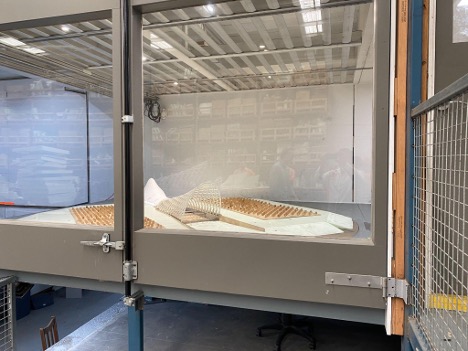
Wind tunnel test through viewing window. Source: Red Stag TimberLab.
Prototyping, fabrication, and precision machining
Delivering a structure of this complexity requires the design and fabrication process to be tightly integrated. Red Stag TimberLab developed prototypes to test-fit key connections and refine CNC detailing early in the process. Additional factory fit testing was completed to ensure fitment of site-applied elements.
Significant innovation was made with the introduction of a new adjustable steel press system for the manufacture of curved glulam elements. Previously taking multiple days per press cycle, the new system enabled daily turnaround, dramatically improving efficiency and throughput.
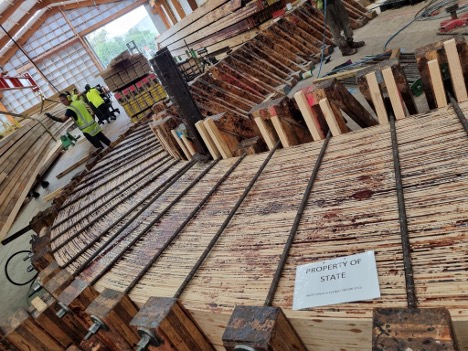
Steel press system. Source: Red Stag TimberLab.
Each arch segment, some as large as 1400 × 300 mm and 30 m long, was pressed over depth and machined at Red Stag’s Auckland facility using 5-axis CNC technology to maintain millimetre precision of shape across the element. Radiata Pine was used throughout, H3.2 treated and bonded with resorcinol glue, finished with CD-50 preservative systems for added durability.
Over 830 timber elements and 500 tonnes of steel brackets and fixings were manufactured and test-fitted off-site before dispatch. Factory assembly included full bracket installation and detailed QC processes, ensuring seamless site assembly and minimised on-site risk.
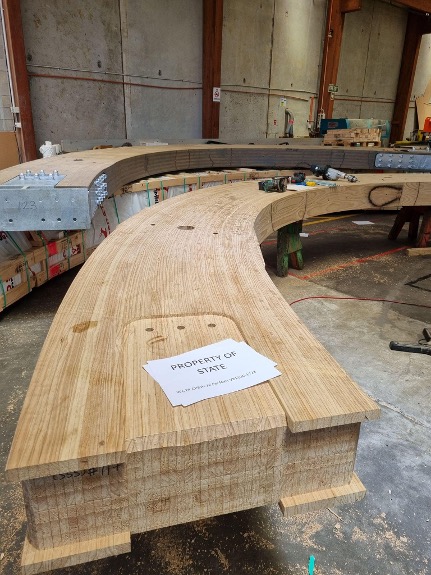
Curved timber elements prior to fit with the steel node. Source: Red Stag TimberLab.
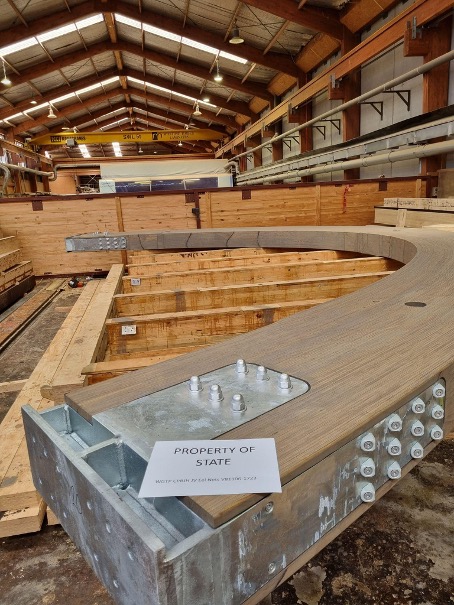
Steel nodes embedded in the curved timber element. Source: Red Stag TimberLab.
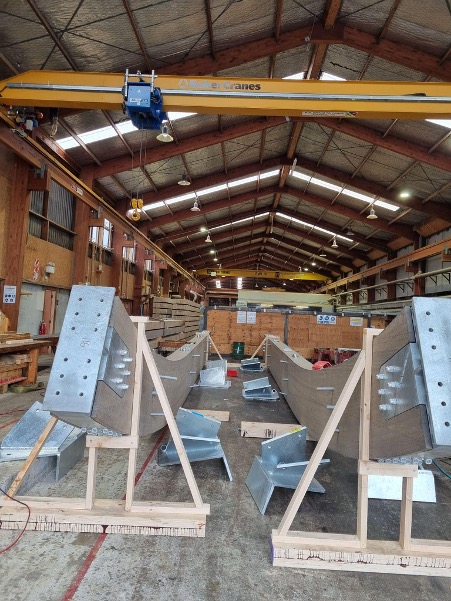
Curved timber elements prior to shipping with intermediate steel nodes fit. Source: Red Stag TimberLab.
Logistics, staging, and construction sequencing
Given the scale and shape of the components, logistics required a hybrid of transport solutions including standard containers, flat rack containers, and charter shipping for oversized elements. A dedicated off-site facility was used in Melbourne for laydown, final pre-assembly, and site delivery staging.
Installation proceeded arch-by-arch, starting from the rear of each portal. After each arch was installed, infill struts and survey checks followed. This staged approach enabled precision assembly alongside active roadways and live work zones.
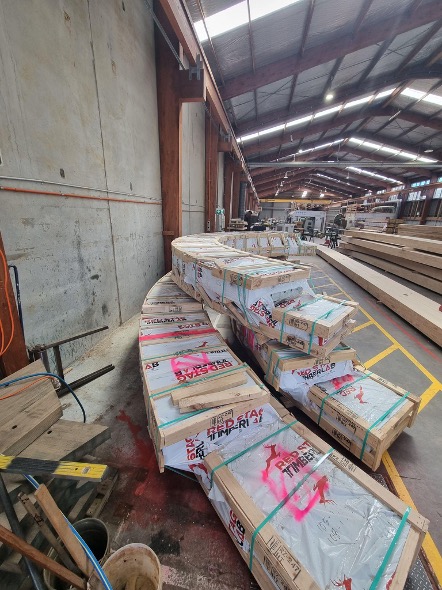
Timber elements protected for shipping in Auckland, New Zealand. Source: Red Stag TimberLab.
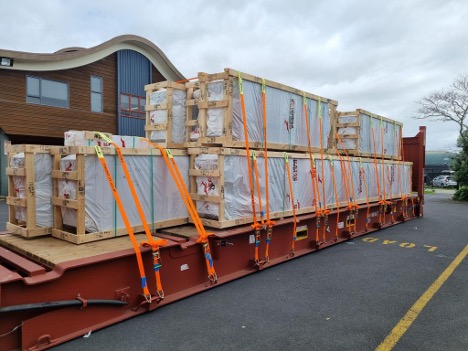
Elements packed on Flat Rack for shipping in Auckland, New Zealand. Source: Red Stag TimberLab.
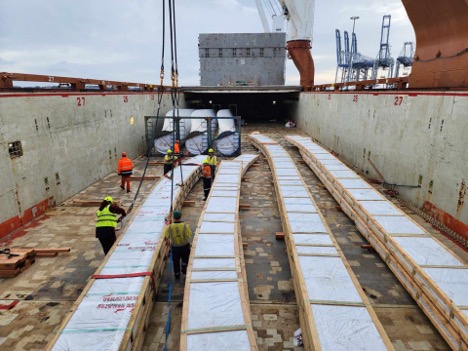
Larger elements loaded for shipping. Source: Red Stag TimberLab.
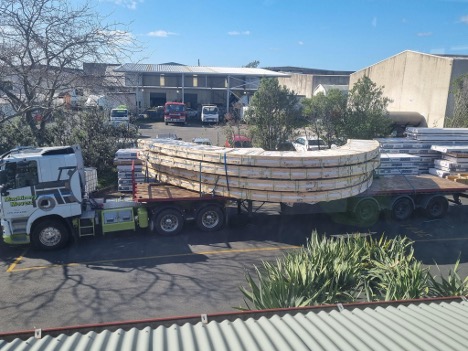
Elements between site and port. Source: Red Stag TimberLab.
Digital fabrication and infrastructure-scale delivery
Although the forms read clearly at speed, they represent a significant effort in design coordination, digital modelling, fabrication integration and construction planning. The completed gateway forms stand as a lasting testament to the collaboration between architects, engineers and fabricators.
For the timber industry, the project is a reminder that high-performance engineered wood is not limited to buildings. When design, fabrication, logistics and construction sequencing are treated as a single system, timber can take its place in the most complex and publicly visible parts of the built environment.
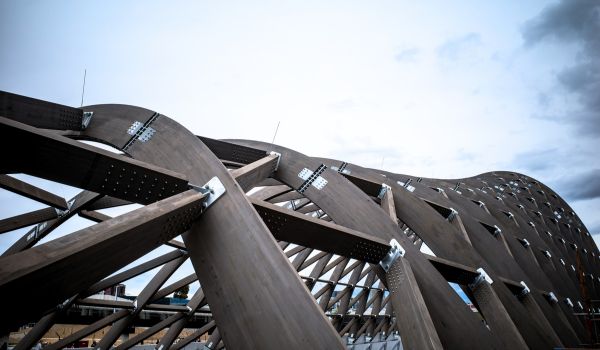
Source: Kurt Cunningham
Why this project matters for timber in Australia
Timber’s role in Australian infrastructure is expanding. Projects at this scale remain pioneering. The West Gate Tunnel portal structures demonstrate what becomes possible when structural design, fabrication, logistics and installation sequencing are treated as one integrated delivery system.
Key takeaways from the realised project include:
- Wind engineering appropriate to the scale of the asset. The structures were treated as wind-dominant, with wind tunnel testing carried out using 1:200 3D printed models to refine global and local pressures.
- Digital fabrication and prototyping as risk control. Connection prototypes, CNC detailing development, and factory fit testing reduced site uncertainty and supported repeatable assembly.
- Manufacturing innovation enabling curved mass timber at scale. A new adjustable steel press system enabled daily turnaround for curved glulam elements, supporting the production program.
- Complex logistics and staged installation delivered deliberately. A hybrid shipping approach (including part-charter shipping for oversized elements) and an off-site Melbourne staging facility supported an arch-by-arch installation sequence with survey checks at each step.
As Australian cities continue to invest in major infrastructure, the West Gate Tunnel Timber Nets demonstrate that mass timber can credibly operate in the most visible and demanding public projects, provided the delivery method matches the ambition.
Credits and Bios
Design & Construct Head Constructor
CPBJH JV
WOOD MARSH key contributor
Roger Wood - Concept Architect
Red Stag TimberLab key contributors
Andrew Hewitt, General Manager
Manu Abraham, Projects Manager
CREATE key contributors
Toby Mason, Project Director Lead Design
Martin Vlnas, Architectural/Structural Detailing
Concept and feasibility (TTW)
Timothy Allen, Associate (Structural)
André Pereira, Digital Director
Learn more about this project by watching the replay here of the WoodSolutions webinar: Westgate Tunnel Engineering, presented by Tim Allen and André Pereira.