CLT Environmental Performance

Timber's environmental credentials are well established - it stores carbon, it comes from renewable sources, and it requires less energy to manufacture than steel or concrete. Environmental claims must be substantiated, not assumed. The environmental performance of a CLT building depends on the specific product, the forest source, the manufacturing process, the transport distance, the building's design life, and the end-of-life pathway.

This article covers how CLT contributes to environmental outcomes - carbon storage, embodied energy, resource efficiency, indoor environment quality, and end-of-life considerations - and the frameworks used to verify those contributions. It provides the evidence base for making credible environmental claims in design documentation, sustainability assessments, and certification submissions.

Key Takeaways

  • CLT stores atmospheric carbon. Timber absorbs CO₂ during growth and retains it as stored carbon throughout the product's service life. A cubic metre of CLT typically stores more carbon than is emitted during its manufacture and transport.
  • Environmental claims should be verified using product-specific Environmental Product Declarations (EPDs), not generic timber data. EPDs provide transparent, third-party-verified data on embodied carbon, energy, water use, and other environmental impacts across the product's life cycle.
  • CLT's off-site fabrication reduces construction waste. CNC machining produces precise cuts with minimal material loss; off-cuts and waste material are recovered at the factory for recycling or energy recovery, rather than being disposed of as site waste.
  • Biophilic effects (the positive human response to natural materials) are a recognised benefit of expressed CLT interiors. Research associates visible timber surfaces with reduced stress, improved mood, and enhanced perceptions of warmth and comfort.
  • Forest certification (FSC or PEFC) provides chain-of-custody verification that the timber originates from sustainably managed sources. Certification should be specified and verified for any project making sustainability claims.
  • End-of-life options for CLT include reuse, recycling, and energy recovery. Design for disassembly (using mechanical connections rather than adhesive bonds at the building level) supports future material recovery.
     

Publications

1. Carbon and Climate

Carbon Storage in Timber

Trees absorb CO₂ from the atmosphere during growth through photosynthesis, converting it to carbon stored in the wood's cellular structure. When timber is harvested and used in construction, this carbon remains stored in the product for the duration of its service life, removing it from the atmosphere.

A cubic metre of softwood CLT stores approximately 0.7-0.9 tonnes of CO₂ equivalent (depending on species and density). For a typical CLT building, the total carbon stored in the structural timber can be substantial, often exceeding the carbon emitted during manufacturing, transport, and construction combined.

This carbon storage is sometimes referred to as "sequestered carbon" or "biogenic carbon." It represents a genuine climate benefit, but it is temporary - the carbon is released if the timber is burned or decomposes at end of life. The climate benefit is maximised when the timber remains in service for as long as possible and is reused or recycled rather than disposed of.

Embodied Carbon Comparison

Life cycle assessment (LCA) studies consistently show that CLT buildings have lower embodied carbon than functionally equivalent buildings constructed from steel or concrete. The carbon advantage arises from two sources: lower manufacturing emissions (less energy-intensive production process) and carbon storage (the timber itself contains stored atmospheric carbon that offsets manufacturing emissions).

The magnitude of the advantage depends on the specific comparison: building type, height, span, services intensity, and the proportion of the structure that is timber all influence the result. Generic claims ("timber is always lower carbon") are less credible than project-specific LCA using product-specific EPD data.

Substitution Effect

Beyond the direct carbon stored in the product, using CLT instead of steel or concrete avoids the emissions that would have been generated by manufacturing those alternative materials. This "substitution effect" is recognised in some carbon accounting frameworks and can be significant, particularly for structural elements where the alternative would be high-emission materials.
 

Environmental Product Declarations (EPDs) are the standard mechanism for communicating a product's environmental performance in a transparent, comparable, and third-party-verified format.

What an EPD Contains

An EPD reports the environmental impacts of a product across defined life cycle stages: 

  • A1: Raw material extraction and processing
  • A2: Transport to the manufacturing plant
  • A3: Manufacturing
  • A4: Transport to site
  • A5: Construction
  • B1-B7: Use phase
  • C1-C4: End of life

Reported impacts typically include global warming potential (embodied carbon), energy consumption (renewable and non-renewable), water use, waste generation, and ozone depletion, acidification, and eutrophication potential.

Using EPDs in Practice

EPDs are used in sustainability assessments (Green Star, NABERS, WELL, Living Building Challenge), LCA studies, carbon accounting and reporting, procurement specifications, and design competition submissions.

When using EPDs, designers should ensure the EPD is current and issued by a recognised programme operator, the EPD covers the specific product being specified (not a generic product category), the life cycle stages reported match the scope of the assessment (cradle-to-gate, cradle-to-grave, or cradle-to-cradle), and comparisons between products use EPDs with equivalent scope and methodology.

CLT manufacturers operating in the Australian market increasingly provide product-specific EPDs. Where an EPD is not available for the specified product, the designer should request one from the manufacturer or use a conservative industry-average dataset with appropriate caveats.
 

The environmental credentials of CLT are only as strong as the forest management practices behind the raw material. Sustainable forest management ensures that timber harvesting does not deplete forest resources, degrade biodiversity, or compromise the carbon storage function of the forest estate.

Certification Schemes

The two internationally recognised forest certification schemes are FSC (Forest Stewardship Council) and PEFC (Programme for the Endorsement of Forest Certification, which endorses national certification schemes including Responsible Wood in Australia).

Both schemes provide chain-of-custody certification that tracks timber from the forest through processing and manufacturing to the final product. Chain-of-custody certification gives designers, specifiers, and building owners confidence that the CLT has been sourced from responsibly managed forests.

Specifying Certified Timber

For projects making sustainability claims or pursuing certification (Green Star, WELL, FSC Project Certification), chain-of-custody certification should be specified in the project documentation and verified at procurement. The specification should state the required certification scheme (FSC, PEFC, or either), the chain-of-custody standard (e.g. FSC-STD-40-004), and any minimum percentage requirements (e.g. FSC Mix Credit).

Plantation Sources and Managed Forests

CLT is predominantly manufactured from softwood species  in plantations, grown specifically for harvest in managed rotations, maximising the tree growth (and carbon removing capacity) of land. Sustainably managed forests in the context of CLT production typically means selective harvesting within a managed forest estate, where harvest rates do not exceed growth rates and biodiversity and ecosystem values are maintained.

This is distinct from old-growth harvesting or deforestation. The timber supply chain for CLT is based on renewable, managed forestry.
 

Manufacturing Efficiency

CLT manufacturing is inherently resource-efficient. The process converts sawn boards into large structural panels with minimal waste, finger jointing allows the use of shorter board lengths (utilising material that might otherwise be downgraded or discarded), CNC machining produces precise cuts with controlled off-cut generation, and factory waste streams (sawdust, off-cuts, rejected boards) are recovered for recycling, biomass energy, or secondary products.

Construction Waste

Off-site fabrication significantly reduces construction waste compared to in-situ construction methods. Panels arrive on site cut to specification: With careful planning there is no on-site cutting, no formwork, and no wet-trade waste (no concrete, no render, no plaster in the structural system).

Where site cutting does occur, waste timber can be collected and recycled. The overall waste intensity (waste per square metre of floor area) of CLT construction is typically lower than for equivalent concrete or steel buildings.

Design for Material Efficiency

CLT panel design can be optimised for material efficiency by matching panel thickness to structural demand (avoiding over-specification), using standard panel dimensions where possible to reduce off-cuts, coordinating opening locations to minimise waste during CNC machining, and considering hybrid systems (CLT floors with glulam beams, for example) that use each product where it is most efficient.
 

Biophilic Effects

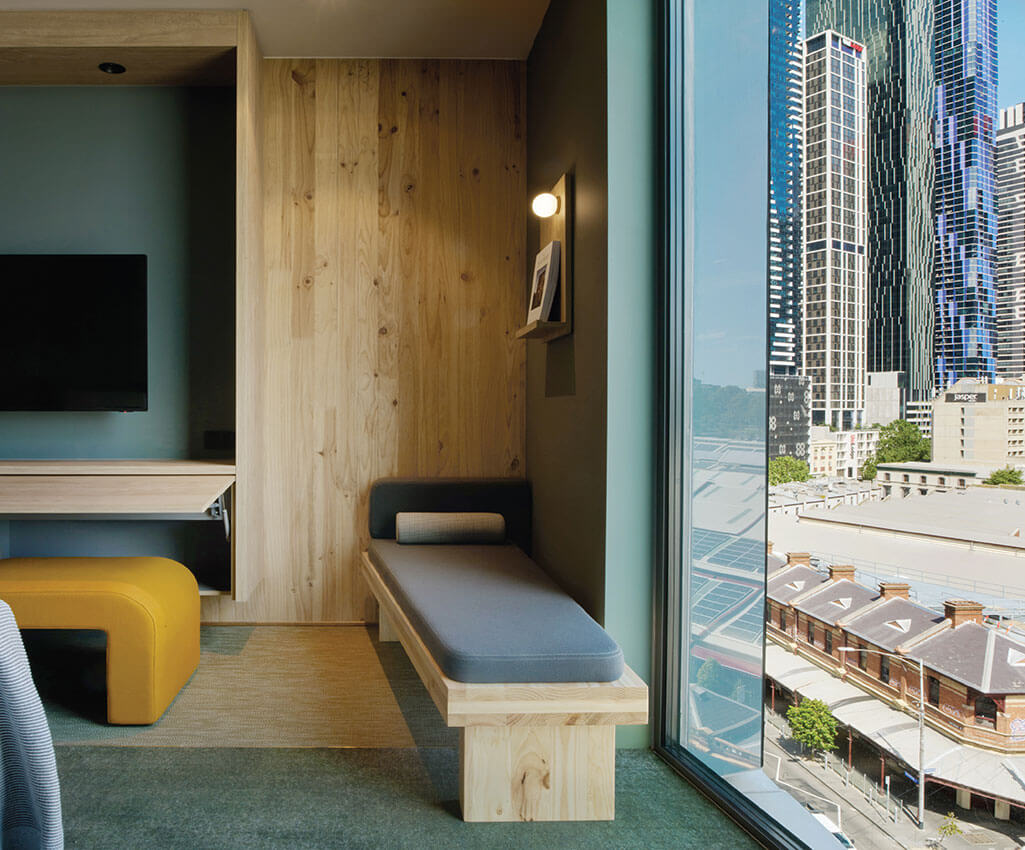
Where CLT is expressed as a finished interior surface, it contributes directly to the indoor environment. Research consistently associates visible timber surfaces with reduced physiological stress (lower heart rate, blood pressure, and cortisol levels), improved psychological wellbeing (reduced anxiety, improved mood), enhanced perceptions of warmth, comfort, and naturalness, and increased satisfaction with the built environment.

These biophilic effects are increasingly valued in workplace, education, and healthcare design. They can support wellness certification frameworks (WELL Building Standard) and contribute to occupant satisfaction and productivity outcomes.

The biophilic benefit is not automatic, it depends on the proportion and quality of visible timber. Expressed CLT ceilings, wall panels, and structural elements all contribute. The design decision about which surfaces to express therefore has environmental, aesthetic, and wellbeing dimensions.

Indoor Air Quality

CLT's contribution to indoor air quality depends primarily on the adhesive system and any applied surface finishes. PUR adhesives are formaldehyde-free and generally achieve favourable ratings under indoor air quality assessment frameworks. MUF adhesives contain formaldehyde and may require specification of low-emission formulations.

Surface coatings, sealants, and finishes applied to expressed CLT surfaces should also be assessed for VOC emissions. Low-VOC or zero-VOC products should be specified where indoor air quality performance is important.
For detailed guidance on adhesive systems and their implications, see CLT Material Properties and Manufacture.

Thermal Comfort

CLT contributes to thermal comfort through its moderate thermal mass (lower than concrete, higher than lightweight timber frame), its contribution to building airtightness (large panels with sealed joints reduce air leakage), and its surface temperature characteristics (timber surfaces feel warmer to the touch than concrete or steel at the same ambient temperature).

These properties are design parameters that interact with insulation, glazing, HVAC design, and passive strategies. They do not eliminate the need for insulation or energy-efficient design, but they can complement it.
 

Design for Disassembly

CLT buildings can be designed for disassembly - enabling panels to be recovered, reused, or recycled at the end of the building's service life. Design for disassembly requires mechanical connections (screws, bolts, brackets) rather than permanent adhesive bonds at the building level, documentation of panel specifications, connection details, and material properties for future reference, and design decisions that anticipate future deconstruction (accessible connections, separable assemblies).

Design for disassembly is an emerging priority in sustainable construction and is increasingly recognised in certification frameworks and circular economy assessments.

Reuse and Recycling

Recovered CLT panels can potentially be reused in new construction (subject to assessment of structural integrity and residual service life), recycled into secondary timber products (particleboard, fibreboard, animal bedding), or used as biomass fuel for energy recovery.

The feasibility of reuse depends on the condition of the recovered panels, the connection method used in the original building, and the availability of assessment and certification pathways for second-life structural timber. This is an evolving area, as the first generation of CLT buildings approaches the end of its initial service life, the practical frameworks for panel recovery and reuse will develop.

Carbon at End of Life

The carbon stored in CLT is released if the timber is burned (as CO₂) or decomposes in landfill (as CO₂ and methane). If the timber is reused or recycled into long-lived products, the carbon remains stored.

End-of-life carbon accounting is an important consideration in whole-of-life LCA. The most favourable environmental outcome is achieved by maximising the building's service life, designing for disassembly and reuse, and recovering material for recycling where reuse is not feasible.